Showing posts with label punctuation. Show all posts
Showing posts with label punctuation. Show all posts
Sunday, 27 January 2013
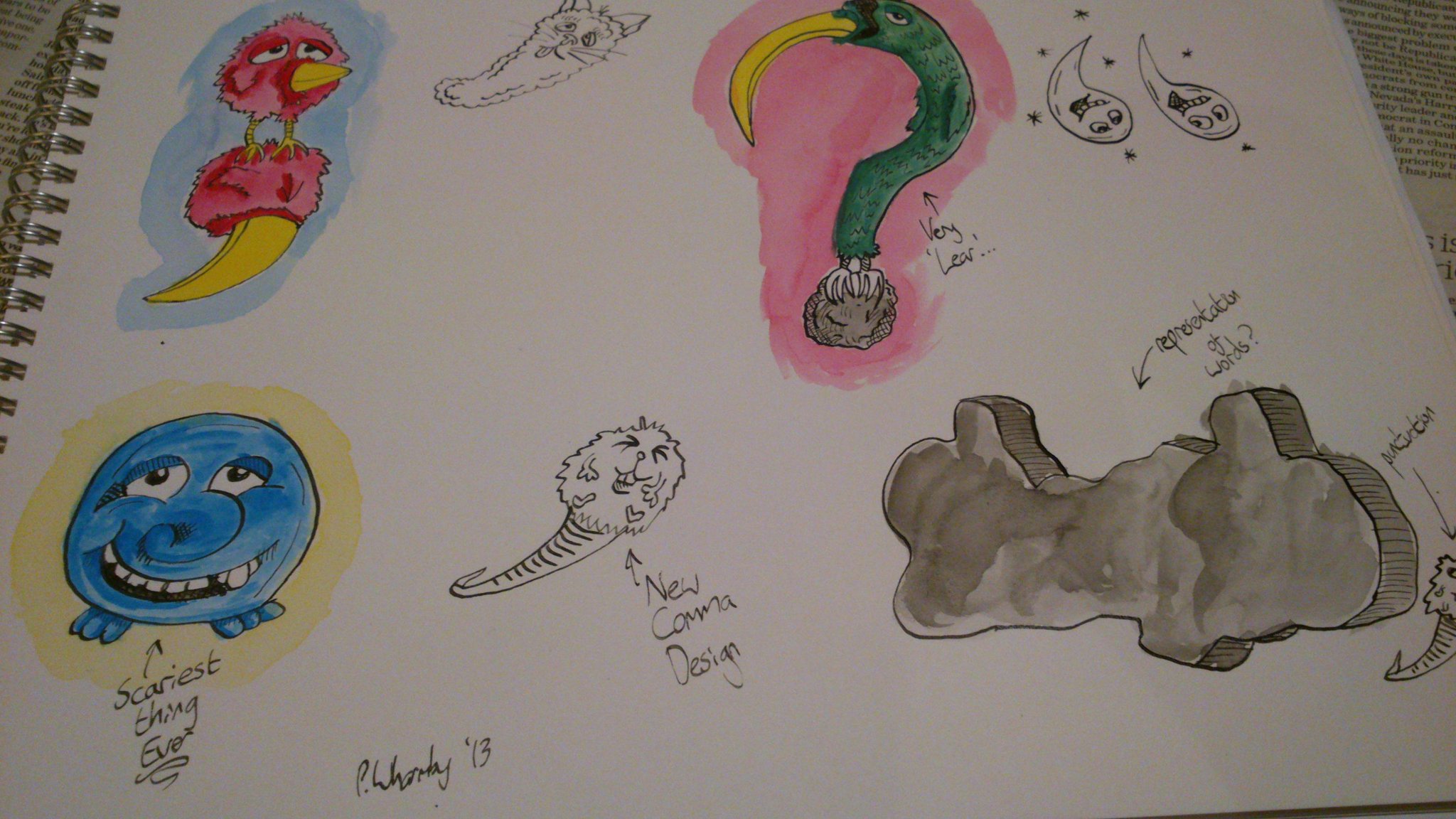
Punctuation Pets on Paper!
Here's my first attempt at properly drawn Pets, without the aid of a computer. They look a bit different, but I'm sure that;'s just teething problems. I've created a new Comma, to replace the derivative and boring caterpillar thing - he's much more fun.
Let me know what you think!

Sunday, 20 January 2013
Commas
What is it with commas? At first glance they appear to be an easy-to-understand branch of the punctuation tree; a straightforward mark that only the worst dunces can possibly mess up. This is certainly the attitude that my students have for this poor, misunderstood piece of typography. 'We learned how to use commas in year 2,' they cry in unison, 'we need no more instruction in this barren mark.' They then proceed to merrily splice their way through their work, like Dr. Moreau.

Lists they understand. This is the one punctuation mark that they are supremely confident of, and rightly so. The problem is that lists feature very lightly in work written post KS2 - they are not a common sight in your average essay or film review. So their happiest times with commas are removed from them, and they are left, arrogantly flailing, in a morass of misunderstood rules and commas after connectives. The poor devils. Recently I've made punctuation my life's work, or so it seems. I spend a great amount of my time trying to find ways to engage students in it, and also instruct them as to their use. And this is tricky, as the rules are convoluted and time-consuming, and yet I find I cannot just fob them off. I can't say to a class that commas are where you breathe. I just can't. The main reason for my truculence on the matter is because simplistic rules like this don't work and lead to terrible misapprehensions. No, it's much better to teach them exactly how punctuation works, so they can cope with any eventuality.
With semi-colons and full stops this is an achievable aim. I can even get apostrophes into their eager little heads with some ease. But commas give me nightmares. Their rules are seemingly simple, but getting them across to students is incredibly hard. Let's start with the subordinate clause and its associated comma. In order to teach students this, they have to grasp the concept of a subordinate clause. This also means they have to understand the concept of 'sentence'. Have you asked a student what a sentence is recently? If not, give it a go. It's a hoot. And the trouble is, how does one define a sentence in easy-to-grasp language? It is a single unit of meaning? What's meaning? It's a single utterance formed around a verb? God help us - what's a verb again? It's a penguin? Yes. It's a penguin. A single, functioning, happy penguin. That'll do. And this is what I use to get across the whole spectrum of sentences, compounds and complexes. Three penguins in various states of disarray:
Simple sentence = a penguin, happily standing there. He's perfectly all right by himself and cannot be broken down any further. He makes sense, too.
Compound sentence = a penguin with another fully-functioning penguin glued to his back. They both look a bit miffed. They are glued together by the fabled 'Andorbut' glue. So far so mental.
Complex sentence = a penguin wearing a pair of robotic trousers. This is a penguin that has an optional upgrade. The upgrade cannot work alone, of course. No - it needs to living, breathing, functioning penguin to operate. The little seat the penguin sits on is in the shape of a comma.

So, there we are. The compexity of the issue demands bizarre analogies to be formed. Now, it's altogether possible that I've missed a trick here, and that there is some easy way of teaching this without resorting to zoo animals. If so, let me know.
But still, commas and subordination. Tricky.
What about commas and connectives? Pretty easy this, as long as they remember it's comma before connective. Even then, many will get confused why 'and' is exempt from this rule, and whether the writing after 'because' is a subordinate clause or not. For me it all boils down to the 'survival' idea - if a section of text can survive alone, and cannot be broken down into a shorter unit of meaning including a verb, then it's a sentence.
Then we have the splice. I've been reduced to strange analogies again when it comes to this most egregious of punctuation errors. My line with the students is that putting a comma between two full sentences (penguins or whatever) is barbaric. It just can't cope with the pressure and will be squashed flat. They like this idea. I tell them that the only marks strong enough to handle are semi-colons and full stops. Then one smart-arse will pipe up, 'but what about exclamation marks?' Yes, those too. This works pretty well, especially if I draw dead little commas all over their work when I see any splicing going on (I haven't actually done this yet, but I sure am going to start now).
But even with this arsenal of weird ideas, I still don't feel I've got a complete handle on their comma ability. There must be other ways to achieve full comma-ability - any ideas?
Saturday, 1 December 2012
Punctuation Pets - going all Pokemon on them.
Hello everyone. It's a cold December 1st, and now the joy I gained from my advent calendar has waned, it's time for another post.
Yesterday, trying to engage my Yr8 literacy-boosting group with the idea of apostrophes, I hit upon the idea of presenting them as an endangered species, struggling to survive in the modern world. I led the students along a while - one of my favourite techniques - wanting them to think we were going to talk about snow leopards or minke whales or something. Then I hit them with the apostrophe, and a suitably cute illustration of what an apostrophe looks like under a magnifying glass.
This had them hooked. Now, I understand that engagement is not the same as learning, but it is certainly a damn good foundation to it. Over the course of the session, I instilled in them a sense that missing out an apostrophe was a little like saying 'I don't believe in fairies'. After they'd stopped sobbing at the thought of the needless murder of hundreds of little apostrophes, we decided it was time to act. So, every time an apostrophe is placed in their own natural habitat (possession/omission), we will make a point of adding another line to the tally of happy, healthy apostrophes living in the wild.
The rationale behind all this childish madness is this: students usually understand apostrophe rules (and those for capitals, commas, full stops and connectives); the issue is that they just forget to use them as they write at speed, usually under pressure. It is this forgetfulness which needs work, and what better way to help them remember than giving punctuation personality? In our school, with the help of literacy-freak @letterland123, we are hoping to create a Pokemon-inspired 'points gathering' affair, whereby punctuation is very cute, collectible and a source of small prizes. Watch this space...
 |
| An endangered Apostrophe |
This had them hooked. Now, I understand that engagement is not the same as learning, but it is certainly a damn good foundation to it. Over the course of the session, I instilled in them a sense that missing out an apostrophe was a little like saying 'I don't believe in fairies'. After they'd stopped sobbing at the thought of the needless murder of hundreds of little apostrophes, we decided it was time to act. So, every time an apostrophe is placed in their own natural habitat (possession/omission), we will make a point of adding another line to the tally of happy, healthy apostrophes living in the wild.
The rationale behind all this childish madness is this: students usually understand apostrophe rules (and those for capitals, commas, full stops and connectives); the issue is that they just forget to use them as they write at speed, usually under pressure. It is this forgetfulness which needs work, and what better way to help them remember than giving punctuation personality? In our school, with the help of literacy-freak @letterland123, we are hoping to create a Pokemon-inspired 'points gathering' affair, whereby punctuation is very cute, collectible and a source of small prizes. Watch this space...
Subscribe to:
Posts (Atom)