Now I had managed to communicate with the primary schools and agree to work with them, what did I actually do?
As I have already said, the main reason my job existed was to push our school and make it a more attractive proposition for Year 7. I may have managed to soften this objective for my own sense of well-being into one that was primarily about helping students, but I still had to deliver for the powers-that-be. This meant that any time working with Year 6 was essentially time wasted, as they had already made their minds up. Far better to work with Years 4 and 5, as the decision was still pending for them, and therefore there was plenty of opportunity to get them to consider our little school. The trouble was, the primaries were very keen indeed for me to work with their Year 6s - the looming SATs were clearly on their minds, and my offer of helping with 'reading and writing' was very attractive. For the first two terms of this outreach (Christmas and January terms), Year 6 was all I was offered.
Aware that it was unhelpful to my main objective, I took the work anyway. I reasoned that many of the students I was going to work with were to end up at my school anyway, so it would aid transition (especially useful now I am Head of English, so quite a useful 'familiar face' for them to have - though I didn't know this at the time). It was probably going to help raise my profile within the schools too - allowing me to work with the Year 4 and 5 students later on in the year. So I planned some a detailed writing unit for these Year 6 classes. I had them once a week, for around an hour, for a whole term. This meant I needed seven full lessons that really engaged them with writing (the skill their teachers had identified as being weaker). I created a unit based loosely on The Demon Headmaster and Boy, by Roald Dahl: the concept was a short story, with character development and clear structuring, about a new headteacher who turned out to be 'odd' in some way. Each week focused on a different skill, utilising 'slow writing' techniques a great deal: cohesion one week, detail and imagery the next, punctuation a third and so on, until the students were ready to create their delightful little tales. With a clutch of level 5 and 6 workunder their belts, the students were happy to have made progress, and the primaries were more willing to let me work with students from further down the school.
I did some reading work, again based on Boy, with some Year 5s, focusing on the skill of inference and evidence gathering. Year 4 students worked with me on a writing topic based on the Titanic, focused on finding the 'joy' in writing and developing vocabulary and simile creation. Some Year 3 students, and goodness me they were tiny and quite frightening at times (they are so very different even to Year 7s), worked on a speaking and listening topic, again based on the Titanic (stick with what you know, that's my motto!) where they created really quite startlingly professional TV news reports on the sinking. Jabberwocky was a focus for another group of Year 5s, where we worked on creating meaning through language, ensuring every word counted. All of these units were around one hour a week for about a term, and I think in total I must have worked with over one hundred students from around the town.
However, there was a problem. I was able to collect work, mark it and share it with them, but I had no idea about progress over time. It was difficult to liaise with their class teachers, so by the end of the year I was aware that I had no idea - really no idea at all - whether I had had a positive impact on their progress. It dawns on me that this is likely the biggest downfall to the programme. As a teacher who is very much led by marking and then developing work, this was hard to handle; in the end I had to content myself with the fact that I was very unlikely to be doing educational harm to these students, and to liaise with the primaries over their SATs results whenever I could. As these things should always end with an evaluative note, checking progress would be an area of development for the next time I make it to the primaries.
So, my year was over. I had managed to get myself promoted to Head of Department by May, so it is clear to me that I will be spending far less time in the primary schools in 2014-15. Cross-phase standardisation, moderation and joint planning had taken baby steps, but were by no means fully implemented, and I had worked with more Year 6s than I'd wanted to. On the other hand, the units of work had been enthusiastically received, and communication routes had been set up between the schools, and we saw a raise of around 25 students entering for Year 7, so all in all, it wasn't a bad year.
Showing posts with label guide. Show all posts
Showing posts with label guide. Show all posts
Tuesday, 26 August 2014

Sunday, 17 August 2014
My year as a 'Cross Phase Leader' Part 1
Back in May 2013, I was given a promotion. It was a Second in Department job of sorts, having responsibility for KS3 curriculum and assessment, and a 50% timetable. This seems very generous, but I was expected to spend that time doing something else entirely - working with primary schools.
Schools try many different methods of communicating with their partner primary schools, and can spend a lot of money, or very little. The importance of such work is generally accepted, though it is often hard to pin down exactly what benefits we are expecting to reap from transition efforts. Often it's a simple case of attracting Year 4 and 5 students to our schools - advertising the quality of the place to the main consumers; sometimes it's a worthy desire to help the students cope with the terrifying change of scenery and routine; occasionally, and I whisper it, it can be through a need to tick the appropriate box.
Happily, in my case, the first two reasons were paramount. We are a small school, struggling in a very competitive area with two other, much longer-established secondaries. The work of the four Cross Phase Leaders (English, Maths, STEM and PE) was in many ways simple: attract more students to our school, to help keep it viable. However, this is a desperately 'private sector' approach, and clashed with my woolly lefty personality of education being for the kids, so I had to smother this core concern in a more Pete-friendly smock of 'helping students'. I reasoned we in the English department could learn a lot from our peers in the primaries, and could engage in very practical issues such as cross-phase moderation, standardisation and possibly even planning. I also wanted to take my own particular brand of teaching down to the Year 4s and 5s, hopefully working with them on projects that they wouldn't normally get involved in. In short, I was trying to achieve quite a lot.
Once September 2013 came along, the order of the day was networking. It's astonishing how few contacts we had with the primary schools. We could easily get in touch with the heads of our main 'feeder' schools, of course...but what about the other schools - the ones we were interested in, as they would enlarge our catchment? By the end of the year I had made contact with, and worked with, about 70% of the town's primaries, but what a hell of a job this was. The break-through came in the form of the town's primary Literacy meetings which take place three times a year. These have a teacher from every primary, and they spend time discussing curriculum changes and SATS. Once I had infiltrated this - actually inviting them to have their January meeting in our school library - the rest was easy. I chaired the meeting, chatted to everyone, got their emails and that was that: easy access to every primary. Having a key contact in every school is very useful - it may be their Literacy Co-ordinator, their deputy head, or a class teacher, but it doesn't matter. What you need is an ally who will organise things at their end, spread the word and act as a point of contact whenever you want to work with the students at their school.
Before starting the job, we CPLs had been warned of the difficulty of communicating with primary colleagues. We were told horror stories of teachers who never check emails, or who are actively hostile to any secondary teachers who dare to enter their domain. I was expecting to meet endless walls of resistance, but what I found in reality were warm welcomes and eager requests for help. Most of the primary colleagues were incredibly keen to let me work with their students on 'different' work. Any extra input on reading or writing skills was instantly snapped up, to the point where it became difficult for me to juggle everything. The 50% timetable began to look too heavy. In truth, I was astonished at how willing primary teachers were to get me in front of their students; but then I considered - if someone was willing to drop in and teach my Year 10 class once a week, freeing me up, I'd jump at the chance too.
The horror stories had been over-elaborate and exaggerated. The job of working with multiple primaries across town seemed to be a little more achievable.
Part 2 will be about what I actually did in the primaries.
Schools try many different methods of communicating with their partner primary schools, and can spend a lot of money, or very little. The importance of such work is generally accepted, though it is often hard to pin down exactly what benefits we are expecting to reap from transition efforts. Often it's a simple case of attracting Year 4 and 5 students to our schools - advertising the quality of the place to the main consumers; sometimes it's a worthy desire to help the students cope with the terrifying change of scenery and routine; occasionally, and I whisper it, it can be through a need to tick the appropriate box.
Happily, in my case, the first two reasons were paramount. We are a small school, struggling in a very competitive area with two other, much longer-established secondaries. The work of the four Cross Phase Leaders (English, Maths, STEM and PE) was in many ways simple: attract more students to our school, to help keep it viable. However, this is a desperately 'private sector' approach, and clashed with my woolly lefty personality of education being for the kids, so I had to smother this core concern in a more Pete-friendly smock of 'helping students'. I reasoned we in the English department could learn a lot from our peers in the primaries, and could engage in very practical issues such as cross-phase moderation, standardisation and possibly even planning. I also wanted to take my own particular brand of teaching down to the Year 4s and 5s, hopefully working with them on projects that they wouldn't normally get involved in. In short, I was trying to achieve quite a lot.
Once September 2013 came along, the order of the day was networking. It's astonishing how few contacts we had with the primary schools. We could easily get in touch with the heads of our main 'feeder' schools, of course...but what about the other schools - the ones we were interested in, as they would enlarge our catchment? By the end of the year I had made contact with, and worked with, about 70% of the town's primaries, but what a hell of a job this was. The break-through came in the form of the town's primary Literacy meetings which take place three times a year. These have a teacher from every primary, and they spend time discussing curriculum changes and SATS. Once I had infiltrated this - actually inviting them to have their January meeting in our school library - the rest was easy. I chaired the meeting, chatted to everyone, got their emails and that was that: easy access to every primary. Having a key contact in every school is very useful - it may be their Literacy Co-ordinator, their deputy head, or a class teacher, but it doesn't matter. What you need is an ally who will organise things at their end, spread the word and act as a point of contact whenever you want to work with the students at their school.
Before starting the job, we CPLs had been warned of the difficulty of communicating with primary colleagues. We were told horror stories of teachers who never check emails, or who are actively hostile to any secondary teachers who dare to enter their domain. I was expecting to meet endless walls of resistance, but what I found in reality were warm welcomes and eager requests for help. Most of the primary colleagues were incredibly keen to let me work with their students on 'different' work. Any extra input on reading or writing skills was instantly snapped up, to the point where it became difficult for me to juggle everything. The 50% timetable began to look too heavy. In truth, I was astonished at how willing primary teachers were to get me in front of their students; but then I considered - if someone was willing to drop in and teach my Year 10 class once a week, freeing me up, I'd jump at the chance too.
The horror stories had been over-elaborate and exaggerated. The job of working with multiple primaries across town seemed to be a little more achievable.
Part 2 will be about what I actually did in the primaries.
Thursday, 15 August 2013
Things to do on Results Day
Hello. It's that time of year again - the fortnight of horrible Thursdays. Results day scares me a great deal. It is partly the importance of the grades on the students: have they achieved what they have to achieve in order to progress through life happily and fulfilled? This weighs heavy on any teacher's mind this next two weeks, and yet is probably outstripped by the more selfish, yet arguably more important (to the teacher themselves) question of 'how do these results reflect my ability?' Like it or not, the grades awarded to students after one or two years of teaching from you do reflect your teaching ability. Yes yes, I understand the old adage about horses and drinking but still - ignoring your input on their grades is foolish and would lead to a logical conclusion of removing teachers altogether if gone the full distance. We can bleat as much as we like about the little terrors ignoring us or not revising, but ultimately, your ability to teach and aid them learn has a huge, huge effect on their results.
So this is quite a lot of pressure.
I am terrified of letting the students down, you see. It keeps me awake at night, sometimes - the very idea that I could have explained something more clearly, or used a more effective activity to practice a skill. This is the torture of any professional left to their own devices - I'm sure doctors and lawyers recognise the feeling. It's an integral part of reflective practice and is, therefore, ultimately a good thing. However, it still remains a fact that the whole thing is horribly stressful.
So, here's my tips on what to do on results day 1 or 2 (you know what I mean):
1. Only go to one of them, unless you have responsibility in that area. This is obvious - don't go through it twice if you don't need to. I know this seems a little uncaring, or even unprofessional, but it isn't. Your presence on results day is far from vital, especially if you only teach Year 12 - you'll see them in September. Wait for the email and do your analysis in comfort at home, at your own pace. This will give you the breathing space you need to work out how the students did and what comes next.
2. When you do go in, spend most of the time talking to the students. This is the only worthwhile way to spend results day if you're in school. Analysis and worrying can come later at home with a glass of wine. If you trouble yourself to go into school, you're only really doing it to see the kids, so chat with them, advise them, console them if need be. That's the way forward.
3. Be on holiday. If you really can't cope with the stress in the midst of your mega-downtime, then wait until September before you engage with it at all. Unless you're a HoD or higher, you can get away with this - do it if the alternative is losing your mind. Being away (preferably abroad, away from the British media) is the perfect way of making it so you don't even know it's results day. It's not cowardice - just self-preservation.
4. Do not read the papers on the day. Don't even be tempted. It'll only make you angry and belittle your years of hard work as they bleat about rising standards, as if they're a bad thing. Honestly, it's as if all that money and expertise spent on improving education over the last 20 years was meant to yield no results at all, isn't it? The logic of the papers (and the Daily Hate Mail in particular) is astonishing.
So there we are, four ways to help maintain your professional sanity today and next Thursday. I do hope they help.
So this is quite a lot of pressure.
I am terrified of letting the students down, you see. It keeps me awake at night, sometimes - the very idea that I could have explained something more clearly, or used a more effective activity to practice a skill. This is the torture of any professional left to their own devices - I'm sure doctors and lawyers recognise the feeling. It's an integral part of reflective practice and is, therefore, ultimately a good thing. However, it still remains a fact that the whole thing is horribly stressful.
So, here's my tips on what to do on results day 1 or 2 (you know what I mean):
1. Only go to one of them, unless you have responsibility in that area. This is obvious - don't go through it twice if you don't need to. I know this seems a little uncaring, or even unprofessional, but it isn't. Your presence on results day is far from vital, especially if you only teach Year 12 - you'll see them in September. Wait for the email and do your analysis in comfort at home, at your own pace. This will give you the breathing space you need to work out how the students did and what comes next.
2. When you do go in, spend most of the time talking to the students. This is the only worthwhile way to spend results day if you're in school. Analysis and worrying can come later at home with a glass of wine. If you trouble yourself to go into school, you're only really doing it to see the kids, so chat with them, advise them, console them if need be. That's the way forward.
3. Be on holiday. If you really can't cope with the stress in the midst of your mega-downtime, then wait until September before you engage with it at all. Unless you're a HoD or higher, you can get away with this - do it if the alternative is losing your mind. Being away (preferably abroad, away from the British media) is the perfect way of making it so you don't even know it's results day. It's not cowardice - just self-preservation.
4. Do not read the papers on the day. Don't even be tempted. It'll only make you angry and belittle your years of hard work as they bleat about rising standards, as if they're a bad thing. Honestly, it's as if all that money and expertise spent on improving education over the last 20 years was meant to yield no results at all, isn't it? The logic of the papers (and the Daily Hate Mail in particular) is astonishing.
So there we are, four ways to help maintain your professional sanity today and next Thursday. I do hope they help.
Friday, 2 August 2013
Headaches
I seem to get headaches a lot. I get them so often, that I'm starting to view them dispassionately, trying to figure out what caused them, where the sensation actually is, what positions/movements affect them and why/how they eventually go off. As such, I feel I can now publish my Headache Spotter's Guide and help out all fellow sufferers of the malady.
Headache #1
The Eye One
Centered around one of the eye sockets, epicentre usually seemingly in the very bone of the skull, in mockery of your vain attempts to massage the pain away. A constant, dull soreness, no throbbing with occasional flurries of excruciating pain when looking at bright light or laughing. Affected by light, thinking hard about difficult matters, blocked nose, poor eyesight. Cure: glasses, closing eyes, time.
Headache #2
The Neck One
Centered at the base of the skull and top of the neck, epicentre is apparently your very spinal column: the very think that makes you a vertebrate fighting back. Pain also spread around muscles in that area. Muscle pain, mostly, but with an insistence that is frankly rude, and prevents you from doing anything useful. Affected by sleeping position, weight of head, amount of nodding, dancing wildly to anything pre-1984. Cure: Neck brace, sleeping with only one pillow, neck massage, decapitation.
Headache #3
The Brain One
Floating freely around your cranium, epicentre is everywhere at once and makes you sad. The entire dome of your head becomes an upturned basket of pain, spilling agony out into the rest of your head and often, if you're lucky, your teeth too. Pain comes in many forms, but usually throbbing and inconsistent pain that will continually kid you into thinking its gone, before striking you down with a bolt of fire when you try getting out of your seat. Affected by everything, but especially aggravated by thirst, lack of sleep, lust and needing the loo. Cure: painkillers, silence and sleep.
Headache #4
Migraine
Different for everyone, and probably less common than you'd think. People who've had one are obvious - you can sense it in the clear fear they show when discussing the subject, and their avoidance of anything that could possibly lead to another episode. Pain is intense and debilitating, making you disinclined to socialising, reading or being alive a second longer. Can be accompanied, or preceded by aura, which is an impossible term to define but basically consists of the brain going haywire and fooling the key senses into thinking nonsense, such as talking bees spreading from growing cracks in your vision, to the all-pervading smell of garlic invading your entire head. Or just blurriness and discolouration in what you look at. Affected by continuing to exist and all its trappings. Cure: unknown.
Headache #1
The Eye One
Centered around one of the eye sockets, epicentre usually seemingly in the very bone of the skull, in mockery of your vain attempts to massage the pain away. A constant, dull soreness, no throbbing with occasional flurries of excruciating pain when looking at bright light or laughing. Affected by light, thinking hard about difficult matters, blocked nose, poor eyesight. Cure: glasses, closing eyes, time.
Headache #2
The Neck One
Centered at the base of the skull and top of the neck, epicentre is apparently your very spinal column: the very think that makes you a vertebrate fighting back. Pain also spread around muscles in that area. Muscle pain, mostly, but with an insistence that is frankly rude, and prevents you from doing anything useful. Affected by sleeping position, weight of head, amount of nodding, dancing wildly to anything pre-1984. Cure: Neck brace, sleeping with only one pillow, neck massage, decapitation.
Headache #3
The Brain One
Floating freely around your cranium, epicentre is everywhere at once and makes you sad. The entire dome of your head becomes an upturned basket of pain, spilling agony out into the rest of your head and often, if you're lucky, your teeth too. Pain comes in many forms, but usually throbbing and inconsistent pain that will continually kid you into thinking its gone, before striking you down with a bolt of fire when you try getting out of your seat. Affected by everything, but especially aggravated by thirst, lack of sleep, lust and needing the loo. Cure: painkillers, silence and sleep.
Headache #4
Migraine
Different for everyone, and probably less common than you'd think. People who've had one are obvious - you can sense it in the clear fear they show when discussing the subject, and their avoidance of anything that could possibly lead to another episode. Pain is intense and debilitating, making you disinclined to socialising, reading or being alive a second longer. Can be accompanied, or preceded by aura, which is an impossible term to define but basically consists of the brain going haywire and fooling the key senses into thinking nonsense, such as talking bees spreading from growing cracks in your vision, to the all-pervading smell of garlic invading your entire head. Or just blurriness and discolouration in what you look at. Affected by continuing to exist and all its trappings. Cure: unknown.
Saturday, 2 March 2013
Ghosts
I saw a ghost last weekend. Or at least, that's what a noisy, irrepressibly excitable part of my brain is shouting. It being my birthday, I was watching Skyfall on Blu-Ray (a tremendous experience). Glancing toward the open door leading to the hallway I saw a whiteness pass from the open, darkened bathroom door beyond, into the hall and away from my field of vision.
 I do not believe in ghosts at all. As a youngster I think I hoped that they existed, but due to my scientific bent I have short shrift for anything supernatural. This does not mean I don't find it all fascinating: I have a very deep-seated interest in all things ghostly and mysterious, as I feel it tells us a great deal about the human condition. But I never thought I would see a ghost. And the majority of my brain still insists that I haven't. It was a trick of the light, or even an hallucination, asserts the side of my mind most closely aligned with Occam's Razor. Imagine the implication of actually seeing a spectre in my bathroom: it would firstly mean that my flat is haunted and, quite frankly, sod that. Far too stressful. It would also suggest that there is perhaps life after death (if floating meaninglessly in someone else's bathroom is 'life' in any true sense), and this goes against all of my intuition and education. Far easier to say that it was simply a sham - a trick, amplified by my silly brain.
But here's the thing: how easy it was for my brain to be fooled! I would say I am a fairly sensible chap, with a keen sense of scepticism. I always seek out the most realistic and reasoned arguments for or against anything. And yet, last weekend, just a fleeting peep of something strange has led me to wonder what my waking eyes have seen. I think this, in itself, suggests an answer to the big question: what are all these paranormal witnesses seeing. All those thousands of men and women who have seen ghosts, UFOs, the Loch Ness monster, Pikachu and all, all of them have been fooled by their brains. What they saw was something immeasurably dull - a stick, or a cloud of steam, or a little yellow rat - and their brains, their over-evolved, high-perfomance brains, have filled in the rest of the story. The stick becomes an anachronistic plesiosaur, the cloud of steam a baleful spirit and the yellow rat is suddenly a fictional pocket monster from Japan.
Our wonderful brains are flawed. All you need to do to witness this is see a face in the wood-chip wallpaper round your gran's house, or a smiling clown in the pattern of clouds above you. Your brain wants to see things that aren't there, as it is programmed to seek out movement, forms and most importantly faces. All it took was a mote in my eye, or a gust of wind, to fool my brain into seeing ghosts. And, the trouble is, once its in the mind, it's hard to shake the terror...
And this is the other thing at work, of course. Deep inside our psyche is a strange urge to be terrified. We all merrily seek out things that scare us (I watched Lightfields the other night, sequel to the excellent Marchlands, and spent the whole time peering through my fingers, waiting for a terrifying shock that sadly never came), to the point where we create or invent whole scenarios just to freak ourselves out. On a global scale this leads to theme parks and a thriving horror film industry. On an individual basis, this means telling exaggerated creepy stories and adding malign intention to everyday occurrences, like a fugue in a bathroom.
The myriad ghost stories and legends that litter the UK in particular are testament to these dual drives of wanting to be scared and the brain being able and willing to scare us. The endless reports of ghostly figures, hideous demons and frightening alien encounters are, perhaps, all a product of our own fevered imaginations.
Either that, or they're real.
Part II - my favourite 'real' ghost stories:
1. The Brown Lady of Raynham Hall, with her eyeless sockets and habit of floating down stairs. This photo was taken by a photographer for Country Life magazine who was taking a nice shot of the staircase when he noticed this shape descending the stairs:
 2. The Monk of Newby Church, which is just a photo really, with no associated tale. But it's really tall and incredibly freaky. Estimates suggest it to be around 8' tall, and no evidence of fakery or deception was ever discovered.
 3. The hauntings of Pluckley, Kent. This is the most haunted village in England, with at least 12 roaming spooks. My favourite is the screaming workman in the old quarry. He was crushed by a load of stone, and his scream is still heard on moonless nights...
 4. The ghost bus of Ladbroke Grove: this was a terror in the 1920s, as it blared down the streets, lights blazing, with not a soul on board. Not even a driver. It apparently caused several car accidents.
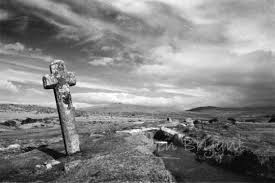
 5. The hairy hands of Dartmoor. These critters materialise in or on your vehicle as you drive down the B3212. They often appear over your own hands on the steering wheel, forcing you off the road. Or, they thump and pat on the walls of your caravan, looking for a way in...
 I do not believe in ghosts at all. As a youngster I think I hoped that they existed, but due to my scientific bent I have short shrift for anything supernatural. This does not mean I don't find it all fascinating: I have a very deep-seated interest in all things ghostly and mysterious, as I feel it tells us a great deal about the human condition. But I never thought I would see a ghost. And the majority of my brain still insists that I haven't. It was a trick of the light, or even an hallucination, asserts the side of my mind most closely aligned with Occam's Razor. Imagine the implication of actually seeing a spectre in my bathroom: it would firstly mean that my flat is haunted and, quite frankly, sod that. Far too stressful. It would also suggest that there is perhaps life after death (if floating meaninglessly in someone else's bathroom is 'life' in any true sense), and this goes against all of my intuition and education. Far easier to say that it was simply a sham - a trick, amplified by my silly brain.
But here's the thing: how easy it was for my brain to be fooled! I would say I am a fairly sensible chap, with a keen sense of scepticism. I always seek out the most realistic and reasoned arguments for or against anything. And yet, last weekend, just a fleeting peep of something strange has led me to wonder what my waking eyes have seen. I think this, in itself, suggests an answer to the big question: what are all these paranormal witnesses seeing. All those thousands of men and women who have seen ghosts, UFOs, the Loch Ness monster, Pikachu and all, all of them have been fooled by their brains. What they saw was something immeasurably dull - a stick, or a cloud of steam, or a little yellow rat - and their brains, their over-evolved, high-perfomance brains, have filled in the rest of the story. The stick becomes an anachronistic plesiosaur, the cloud of steam a baleful spirit and the yellow rat is suddenly a fictional pocket monster from Japan.
Our wonderful brains are flawed. All you need to do to witness this is see a face in the wood-chip wallpaper round your gran's house, or a smiling clown in the pattern of clouds above you. Your brain wants to see things that aren't there, as it is programmed to seek out movement, forms and most importantly faces. All it took was a mote in my eye, or a gust of wind, to fool my brain into seeing ghosts. And, the trouble is, once its in the mind, it's hard to shake the terror...
And this is the other thing at work, of course. Deep inside our psyche is a strange urge to be terrified. We all merrily seek out things that scare us (I watched Lightfields the other night, sequel to the excellent Marchlands, and spent the whole time peering through my fingers, waiting for a terrifying shock that sadly never came), to the point where we create or invent whole scenarios just to freak ourselves out. On a global scale this leads to theme parks and a thriving horror film industry. On an individual basis, this means telling exaggerated creepy stories and adding malign intention to everyday occurrences, like a fugue in a bathroom.
The myriad ghost stories and legends that litter the UK in particular are testament to these dual drives of wanting to be scared and the brain being able and willing to scare us. The endless reports of ghostly figures, hideous demons and frightening alien encounters are, perhaps, all a product of our own fevered imaginations.
Either that, or they're real.
Part II - my favourite 'real' ghost stories:
1. The Brown Lady of Raynham Hall, with her eyeless sockets and habit of floating down stairs. This photo was taken by a photographer for Country Life magazine who was taking a nice shot of the staircase when he noticed this shape descending the stairs:


Saturday, 23 February 2013
Units of work with overarching narratives
The council had decided it. The beautiful village needed a
bypass, and quickly. Deaths on the main
road had been occurring all too often, and it was time to act. Three potential routes were established, and
the villagers quickly decided on the route best for them, their families and
their businesses. Just as the contest
between the routes was getting fierce,
the local vicar was killed in a hit and run incident. There were rumours of murder…
The reasons this unit work so
well are two-fold. One, it embeds
character development into the scheme, giving the students open-ended
opportunity to flesh out their villager, giving them traits, back-stories,
motives and relationships. This leads to
very rich and detailed Speaking and Listening activities, and gives them an
opportunity to add a very strong voice to their writing. Two, it has an over-arching narrative: a
story, that gives all of the written and spoken tasks a distinct purpose and
flavour. Yes, it is a fiction, and I
imagine some would argue that transactional writing in a world of fiction is
meaningless. I would take issue with
this, as the fictional world is grounded in reality and deals with real issues,
but still: there is ample room to create narrative units entirely based in
reality.
So goes the storyline of a KS3
transactional writing/speaking unit of work that I have taught for several
years. Units of work that focus on the
writing of news articles, letters, speeches and the like can be incredibly
boring to teach and to learn from.
Endless lessons of writing different, meaningless letters to imaginary
people can really wear down the motivation of even the happiest students, and
are anathema to those who find school to be an annoyance. I just couldn’t bear to put my students through
this hell, so a few years back I trawled my imagination and dredged my memory
for some way of making a unit of this type fun.
Year 8 English lessons from my own past swam into focus: a village, that
every student is a ‘resident’ of, with careers, social anxieties,
relationships, friendships and deep seated rivalries. This was a unit of work I remembered well,
delivered by my teacher of the time, Mr Fox.
And it was certainly memorable. I
barely remember any peers (apart from close friends) from my school days, but I
certainly remember us all in the drama studio, acting our parts with gusto,
arguing and back-biting about the pros and cons of Bypass Route A. Happy days indeed, so it made eminent sense
to steal this unit, give it some more flourishes and develop it for a full
transactional writing unit.
 |
| The Village - drawn on MS Paint (I'm a masochist). |
So, the story of the village and
its problems provides a backdrop to a range of written and spoken tasks. Travel guides or Wikipedia entries can be
written for the village itself (writing to inform/describe for different
audiences); character biographies can be drafted (writing to entertain and
develop character); newspaper reports and editorials can be written, with a
focus on the difference between certain newspaper types/audiences; even
obituaries and epitaphs, for the poor dead vicar, can be written – it sounds
macabre but the students enjoy trying this formal and prescriptive style for a
change. Spoken tasks can include
speeches from characters about their opposition to council plans; drama
activities based around protests and village hall meetings; full on debates,
even. There’s plenty of scope for
elongating or shortening the unit as you see fit. I found myself adding a sub-plot about finding old manuscripts in the ancient cottage - this involved the class decoding and creating a cohesive storyline from a differentiated range of renaissance-18th Century text excerpts. This acted as a pleasant taster for the next term's unit of work - Twelfth Night.
The students love it, of
course. It’s very engaging, but
obviously this isn’t the be-all and end-all. They
learn an awful lot, too. With their defenses down, they absorb the skills and knowledge quickly, as it all makes more sense, with their writing linked to a central narrative. It all means something, and adds to the overall story. They can
follow their tasks through, recognising that writing a sub-par news report on
the Vicar’s death would show a lack of respect, and would not be print-worthy. They make their editorials truly powerful and persuasive, as they really want a certain by-pass route to be successful. Thus, their learning and practice of
technical aspects, such as punctuation, leap in quality. It’s astonishing how ‘real’ the whole thing
can become, to the point where the students end up leading the narrative,
taking it to strange new places. For
example, we ended up doing some creative writing based on animals being
displaced from their homes. A pupil had
chanced upon an old episode of Animals of
Farthing Wood and wanted to use it.
And it worked brilliantly, with excerpts from Wind in the Willows analysed, and the whole theory and technique of
anthropomorphism explored.
Creating story-driven schemes is time-consuming, but very rewarding. I aim to storify all of my KS3 units in this way - I'm currently sorting out a First World War unit where the progress of the war is tracked by poetry and the biographies of Sassoon and Owen - and I believe that this will create English lessons that will be remembered for a long time. There are limits, of course. It would be unfeasible to create a narrative line in some units, I'm sure - but be imaginative. Media units or transactional writing units can always be given a narrative (I have a Yr 9 writing unit built around the story of a decaying amusement park), and poetry units should be given some kind of central focus or tenet. Novel and play units have their own narrative, of course, and I feel any persuasive module, either spoken or written, should have a story or major project at its heart.
Creating story-driven schemes is time-consuming, but very rewarding. I aim to storify all of my KS3 units in this way - I'm currently sorting out a First World War unit where the progress of the war is tracked by poetry and the biographies of Sassoon and Owen - and I believe that this will create English lessons that will be remembered for a long time. There are limits, of course. It would be unfeasible to create a narrative line in some units, I'm sure - but be imaginative. Media units or transactional writing units can always be given a narrative (I have a Yr 9 writing unit built around the story of a decaying amusement park), and poetry units should be given some kind of central focus or tenet. Novel and play units have their own narrative, of course, and I feel any persuasive module, either spoken or written, should have a story or major project at its heart.
Saturday, 1 December 2012
Punctuation Pets - going all Pokemon on them.
Hello everyone. It's a cold December 1st, and now the joy I gained from my advent calendar has waned, it's time for another post.
Yesterday, trying to engage my Yr8 literacy-boosting group with the idea of apostrophes, I hit upon the idea of presenting them as an endangered species, struggling to survive in the modern world. I led the students along a while - one of my favourite techniques - wanting them to think we were going to talk about snow leopards or minke whales or something. Then I hit them with the apostrophe, and a suitably cute illustration of what an apostrophe looks like under a magnifying glass.
This had them hooked. Now, I understand that engagement is not the same as learning, but it is certainly a damn good foundation to it. Over the course of the session, I instilled in them a sense that missing out an apostrophe was a little like saying 'I don't believe in fairies'. After they'd stopped sobbing at the thought of the needless murder of hundreds of little apostrophes, we decided it was time to act. So, every time an apostrophe is placed in their own natural habitat (possession/omission), we will make a point of adding another line to the tally of happy, healthy apostrophes living in the wild.
The rationale behind all this childish madness is this: students usually understand apostrophe rules (and those for capitals, commas, full stops and connectives); the issue is that they just forget to use them as they write at speed, usually under pressure. It is this forgetfulness which needs work, and what better way to help them remember than giving punctuation personality? In our school, with the help of literacy-freak @letterland123, we are hoping to create a Pokemon-inspired 'points gathering' affair, whereby punctuation is very cute, collectible and a source of small prizes. Watch this space...
 |
| An endangered Apostrophe |
This had them hooked. Now, I understand that engagement is not the same as learning, but it is certainly a damn good foundation to it. Over the course of the session, I instilled in them a sense that missing out an apostrophe was a little like saying 'I don't believe in fairies'. After they'd stopped sobbing at the thought of the needless murder of hundreds of little apostrophes, we decided it was time to act. So, every time an apostrophe is placed in their own natural habitat (possession/omission), we will make a point of adding another line to the tally of happy, healthy apostrophes living in the wild.
The rationale behind all this childish madness is this: students usually understand apostrophe rules (and those for capitals, commas, full stops and connectives); the issue is that they just forget to use them as they write at speed, usually under pressure. It is this forgetfulness which needs work, and what better way to help them remember than giving punctuation personality? In our school, with the help of literacy-freak @letterland123, we are hoping to create a Pokemon-inspired 'points gathering' affair, whereby punctuation is very cute, collectible and a source of small prizes. Watch this space...
Subscribe to:
Posts (Atom)