Day 1
Having the sick bucket beside my leg is no qualification. Upon rumour of sickness at the front of the bus, the bucket was passed nonchalantly away from me, to remove any possibility that I may become embroiled in the ensuing affair. Sadly, I still had to report the incident to the self-appointed vomit-manager - catchphrase, 'I can do sick'. Confused by the ambiguous nature of the verb in this sentence, I simply nodded and retreated back to my seat, humbled and strangely sad.
Wednesday, 24 July 2013

Tuesday, 9 July 2013
Another unfinished scribble...
Grey coffee. Proof that the glorious revolution of Technicolor
of the 1930s was, in fact, simply a scheme designed to drain colour from the
real world to then haphazardly paint it onto Judy Garland’s face. This left only grey outside the cinema’s
doors – a grey that had matured and spread like spilled milk over the years to
the present, resulting in this grey coffee, in its grey cup, on this grey
station platform, underneath this glowering grey sky. Well, thought Jacob as he stared into his
latte, fuck Judy Garland and all the glorious blue in her dress. Today was a
grey day like all the rest, and there was little to be done about that. He glanced again at the departures
television, a 16-inch curved screen from the mid-1980s, and saw that his late
train had been erased from it, the television naïvely assuming that since its
departure time had passed, the train must have set off on its way filled with
happy travellers. A sigh, a frown and a
sip of coffee. Weather was just so
aware, it seemed. Aware of our moods,
aware of our fears and most of all aware of the fact that the 09.47 to King’s
Cross is late and is probably never going to turn up at all.
The platform was busy, as usual, and filled with the sort of people you get on grey June days, waiting for a delayed train. All the benches had been filled, some to overflowing, by large families, overweight men, endless bags, suitcases and rucksacks, all stationary and wondering why they were less comfortable than they would be standing. Jacob didn’t see the point in trying this out for himself: he’d waited in enough stations to know that the seats would be uncomfortable: metal and unyielding, rather like the brilliant yellow train frontages that whizzed by occasionally. So he stood and waited, his grey coffee going cold, his thoughts shifting as he peered down the tracks at the approaching yellow lights that would either continue down to his platform, proving it to be his train, or deviously slink off to the left to Platform Two, a feline manoeuvre designed to sap the soul. A man wearing a hat walked past him to get a better look at this phenomenon, holding a magazine very tightly rolled behind his back. The man peered down the tracks with an eager leaning stance and, not for the first time, Jacob considered the outcome should the old man fall from his ludicrous cranings onto the track. This was something that sometimes held his thoughts – the reaction of your average man (Jacob was kind enough to himself to accept ‘average’ status) to such a disaster. Would he help; could he help? Would he spring like some kind of super hero onto the tracks, lift the man up, grunt heroically, push, heave the man from the rails; jump up at the last minute landing squarely on the platform to be worshipped by the audience - the fat man on the bench? No. Jacob had made a decision before, some years ago. He’d do nothing as he reasoned that he wouldn’t be able to do anything. He’d heard things about how the human mind fails to cope with these disasters, how heroes either didn’t exist or had been around once but were now no more, dodos of humanity. The man stopped craning and stood, rocking happily on his heels.
The
lights got closer, lighting the dark rails and breathing a tired life into the
scene, life that had been fading for some days now, as far as Jacob was
concerned. Edinburgh had been
interesting and even enjoyable on occasion, but it really was time to go home
when you found yourself quietly ranting to yourself about the quality of your
station-bought coffee, and suffering a vague feeling of discomfort whenever you
thought about home, with its associated life and future. As the lights stayed on course and Jacob
gathered his bags this subtle anxiety clawed once more at his stomach, but was
drowned by the last of the lukewarm coffee.
The cup, crushed and crumpled, fell beneath the wheels of the carriages;
Jacob opened the door and climbed aboard, knowing that his reserved seat would
be occupied, and knowing just as well that he hadn’t the wherewithal to effect
any change should this be the case. He noticed the old man with the hat had got
onto the same carriage as him and was sitting at a table seat, eagerly covering
the table with items that were utilized to speed the journey. Jacob sat heavily opposite him, got a quick
smile – interesting smile, almost scared yet backed up by gleeful glittering
eyes – and stowed his bags under his seat.
Gazing from the grimy window at the vacated platform with its innocent
display boards he got another jolt of nerves in his stomach as he thought of
home and the inevitable.The platform was busy, as usual, and filled with the sort of people you get on grey June days, waiting for a delayed train. All the benches had been filled, some to overflowing, by large families, overweight men, endless bags, suitcases and rucksacks, all stationary and wondering why they were less comfortable than they would be standing. Jacob didn’t see the point in trying this out for himself: he’d waited in enough stations to know that the seats would be uncomfortable: metal and unyielding, rather like the brilliant yellow train frontages that whizzed by occasionally. So he stood and waited, his grey coffee going cold, his thoughts shifting as he peered down the tracks at the approaching yellow lights that would either continue down to his platform, proving it to be his train, or deviously slink off to the left to Platform Two, a feline manoeuvre designed to sap the soul. A man wearing a hat walked past him to get a better look at this phenomenon, holding a magazine very tightly rolled behind his back. The man peered down the tracks with an eager leaning stance and, not for the first time, Jacob considered the outcome should the old man fall from his ludicrous cranings onto the track. This was something that sometimes held his thoughts – the reaction of your average man (Jacob was kind enough to himself to accept ‘average’ status) to such a disaster. Would he help; could he help? Would he spring like some kind of super hero onto the tracks, lift the man up, grunt heroically, push, heave the man from the rails; jump up at the last minute landing squarely on the platform to be worshipped by the audience - the fat man on the bench? No. Jacob had made a decision before, some years ago. He’d do nothing as he reasoned that he wouldn’t be able to do anything. He’d heard things about how the human mind fails to cope with these disasters, how heroes either didn’t exist or had been around once but were now no more, dodos of humanity. The man stopped craning and stood, rocking happily on his heels.
“Grey day it is, isn’t it?” Waverley station began to slide by as Jacob looked back at the hat-man opposite, surprised by the sound. He replied,
“Yes, really gives the place a charm.” The man stared. “You know, Edinburgh’s got that quality, hasn’t it: looks good when it’s bleak.” Jacob felt a little stupid for explaining his pithy first comment but the man’s look had drawn it from him. Evidently satisfied, the hat-man smiled again – that odd smile – and continued,
“Was grey yesterday too; did you see the sky yesterday, about three? Furious, it was. Expected a right downpour, didn’t come though”. A pause. “Might come later, way it looks.” Jacob nodded. He felt uncomfortable in this exchange after imagining, in gratuitous detail, what would have happened to this man if he’d fallen in front of a speeding train. He cleared his throat to reply, but too late, “Yep, might come later,” the man continued, gazing at the sky over Arthur’s Seat.
“If it does at least we’ll be miles away from it,” tried Jacob, “shouldn’t cover the whole country, I doubt.” At least this is what he hoped. This greyness, all colour sapped by Dorothy Gale and her Technicolor friends, was getting him down. “It’ll be twenty-two degrees in London, I bet, thanks to that heat-island thing.”
“Heat island?”
Great, thought Jacob. Committed to prolong and intensify this conversation indefinitely. Conversations didn’t happen on trains in Britain unless you were mad, very old or drunk and today Jacob was none of the three. “Yeah, heat islands, it’s the name given to the way large towns and, uh, cities soak up heat. All the people, and buildings, they create their own ecosystem with their own winds,” the man was leaning on the table, truly interested by Jacob’s halting description, “and, uh, weather, almost. Means that places like London – really huge cities – are a lot warmer than the surrounding country.”
“Warmer, but could still be grey, eh?” was the man’s retort. “Just because it’s hotter doesn’t mean it won’t be humid, overcast and damp. Me, I’m going to Peterborough, a place that certainly has no heat island,” snort of laughter, “more a nasty dampness. You’ll have to let me know about the London heat.” The man settled back into his chair, removing his hat in the process.
Let him know. Yes, of course. Jacob waited a moment, expecting more anecdotal gems from the man and, when none seemed imminent, he too settled into his seat, which was now picking up speed outside Portobello. How would I let him know, he thought.
Sunday, 7 July 2013
Of Colds and Summer
I have a cold. It settled upon me on Thursday evening and has clawed deeper into my being since then. I assume I will either recover, painfully and weakly, over the coming months; or it will kill me and probably eat me to boot. It's a nasty cold.
I'm not going to waste my time, or yours, decrying the injustice of a summer cold. Viruses care little for seasonal preferences. Instead, I'm going to consider why we persist in calling it a cold. It really is a most unsatisfactory name for the illness. I would argue, in fact, that it removes even the connotation of disease, due to its very bland and vague nature. What use is a name for a viral disease that makes it sound as if you simply need to put a jumper on?
Because of this, people everywhere have to pretend to be fine when they've got a cold. They have to soldier on, and act as if nothing untoward is wrong at all. Society, combined with linguistics, has left us powerless and guilty on those occasions where we 'catch a cold'. I see this as wrong. Catching a cold is horrid. It's one of the more common viruses out there and it really lays into the victim, often for periods of a week or more. It is usually more debilitating than a bout of tummy trouble (which, at least, people give you sympathy for as you waddle to the loo looking fraught), and is far more of a regular occurrence than, say, typhus. It makes you feel like a slovenly furry animal has taken up residence in your sinuses and is steadily sandpapering the walls in order to redecorate. It makes you very sleepy, and a hazard to other motorists. It forces you to grimace apologetically to an audience of indifferent bastards as your nose transforms into a weir of snot and you desperately grasp for the loose end of the bog roll you're now forced to carry around with you. It's a bad illness.
So, its name needs changing as a matter of some urgency. People need to be allowed to look and feel horrific during the course of the illness, and they need to be able to garner sympathy from the multitude. 'Man flu' has had some vogue recently, mainly due to questionable pseudoscience seemingly performed by GQ magazine, but I fear that it lacks the punch required (and is still, clearly, a derogatory term). I think most of the worst diseases have a hint of Latin or Greek about them. Diphtheria - ends in a vowel, good move. Typhoid - ends in an '-oid', making it sound like a killer robot. Gonorrhea - hard to spell, a definite plus. Legionnaire's Disease - slightly seedy sounding, with extra connotations of the French, excellent.
I think we should begin to call the common cold 'Fisherman's Grehbuloidia'. That would work.
I'm not going to waste my time, or yours, decrying the injustice of a summer cold. Viruses care little for seasonal preferences. Instead, I'm going to consider why we persist in calling it a cold. It really is a most unsatisfactory name for the illness. I would argue, in fact, that it removes even the connotation of disease, due to its very bland and vague nature. What use is a name for a viral disease that makes it sound as if you simply need to put a jumper on?
Because of this, people everywhere have to pretend to be fine when they've got a cold. They have to soldier on, and act as if nothing untoward is wrong at all. Society, combined with linguistics, has left us powerless and guilty on those occasions where we 'catch a cold'. I see this as wrong. Catching a cold is horrid. It's one of the more common viruses out there and it really lays into the victim, often for periods of a week or more. It is usually more debilitating than a bout of tummy trouble (which, at least, people give you sympathy for as you waddle to the loo looking fraught), and is far more of a regular occurrence than, say, typhus. It makes you feel like a slovenly furry animal has taken up residence in your sinuses and is steadily sandpapering the walls in order to redecorate. It makes you very sleepy, and a hazard to other motorists. It forces you to grimace apologetically to an audience of indifferent bastards as your nose transforms into a weir of snot and you desperately grasp for the loose end of the bog roll you're now forced to carry around with you. It's a bad illness.
So, its name needs changing as a matter of some urgency. People need to be allowed to look and feel horrific during the course of the illness, and they need to be able to garner sympathy from the multitude. 'Man flu' has had some vogue recently, mainly due to questionable pseudoscience seemingly performed by GQ magazine, but I fear that it lacks the punch required (and is still, clearly, a derogatory term). I think most of the worst diseases have a hint of Latin or Greek about them. Diphtheria - ends in a vowel, good move. Typhoid - ends in an '-oid', making it sound like a killer robot. Gonorrhea - hard to spell, a definite plus. Legionnaire's Disease - slightly seedy sounding, with extra connotations of the French, excellent.
I think we should begin to call the common cold 'Fisherman's Grehbuloidia'. That would work.
Top 40 albums of the 1990s
Hello everyone; I haven't blogged for months for many reasons, but feel perhaps it's time to crack on a little. There's a bit going around Twitter at present about top 50 90s albums, so thought I'd throw my two penn'orth into the hat. The order is fairly arbitrary, and is subject to change as I progress through time.
40. Hope is Important - Idlewild
39. Definitely Maybe - Oasis
38. Bring it On - Gomez
37. Wowee Zowee - Pavement
36. Mothers Milk - Red Hot Chili Peppers
35. Urban Hymns - The Verve
34. Ten - Pearl Jam
33. Nevermind - Nirvana
32. Parklife - Blur
31. In Utero - Nirvana
30. It's a Shame About Ray - The Lemonheads
29. Up - REM
28. Everything Must Go - Manic Street Preachers
27. OK Computer - Radiohead
26. Dog Man Star - Suede
25. In It For the Money - Supergrass
24. Unchained - Johnny Cash
23. Placebo - Placebo
22. Diva - Annie Lennox
21. Pinkerton - Weezer
20. Grace - Jeff Buckley
19. If You're Feeling Sinister - Belle and Sebastian
18. Odelay - Beck
17. Weezer (Blue) - Weezer
16. Trompe Le Monde - Pixies
15. Beautiful Freak - Eels
14. The Sophtware Slump - Grandaddy
13. Daydream Nation - Sonic Youth
12. Rage Against the Machine - Rage Against the Machine
11. Automatic for the People - REM
10. Doolittle - Pixies
9. Very - The Pet Shop Boys
8. Siamese Dream - Smashing Pumpkins
7. The Colour and the Shape - Foo Fighters
6. Electro-Shock Blues - Eels
5. The Soft Bulletin - Flaming Lips
4. The Holy Bible - Manic Street Preachers
3. Different Class - Pulp
2. Mellon Collie and the Infinite Sadness - Smashing Pumpkins
1. The Bends - Radiohead
40. Hope is Important - Idlewild
39. Definitely Maybe - Oasis
38. Bring it On - Gomez
37. Wowee Zowee - Pavement
36. Mothers Milk - Red Hot Chili Peppers
35. Urban Hymns - The Verve
34. Ten - Pearl Jam
33. Nevermind - Nirvana
32. Parklife - Blur
31. In Utero - Nirvana
30. It's a Shame About Ray - The Lemonheads
29. Up - REM
28. Everything Must Go - Manic Street Preachers
27. OK Computer - Radiohead
26. Dog Man Star - Suede
25. In It For the Money - Supergrass
24. Unchained - Johnny Cash
23. Placebo - Placebo
22. Diva - Annie Lennox
21. Pinkerton - Weezer
20. Grace - Jeff Buckley
19. If You're Feeling Sinister - Belle and Sebastian
18. Odelay - Beck
17. Weezer (Blue) - Weezer
16. Trompe Le Monde - Pixies
15. Beautiful Freak - Eels
14. The Sophtware Slump - Grandaddy
13. Daydream Nation - Sonic Youth
12. Rage Against the Machine - Rage Against the Machine
11. Automatic for the People - REM
10. Doolittle - Pixies
9. Very - The Pet Shop Boys
8. Siamese Dream - Smashing Pumpkins
7. The Colour and the Shape - Foo Fighters
6. Electro-Shock Blues - Eels
5. The Soft Bulletin - Flaming Lips
4. The Holy Bible - Manic Street Preachers
3. Different Class - Pulp
2. Mellon Collie and the Infinite Sadness - Smashing Pumpkins
1. The Bends - Radiohead
Thursday, 11 April 2013
A Midsummer Night's Dream - Bristol Old Vic
The haunting, insistent tapping music created on a load of old planks, carried by a young and inventive cast, proved a high point in this inconsistent yet memorable production at the Old Vic. The planks of wood are the central props in the show, playing a myriad of roles from Oberon's fairy hordes to the jaws of a hunting dog, all controlled by the wonderful choreography of the Handspring Puppet Company (War Horse) and the clever movements of the cast.
Having large hunks of wood in a central role is a brave move in any performance, with the possibility of cliched puns groaning from all quarters. However, it pays off admirably, and I would argue that the work done with the 2 by 4 is probably superior to that done with the more conventional puppets. Their use as instruments, elements of large scale dioramas, creeping tides and waves and forest pathways shows a real creative spark, and lent the whole show a sense of delight that it may otherwise have lacked. The traditional puppets, all creaking joints and mischievous faces, were often lacklustre and even redundent. The acting started reasonably and got an awful lot stronger, leaving the odd homunculi-like doppelganger puppets seeming unnecessary and forced, dragging the attention of the actors (and audience) away from the complex language and plot structure of Shakespeare. Oberon and Titania were stronger - the sparse puppetry used well to create ethereal and otherworldly characters that are very difficult to successfully portray in the usual manner. But it was the planks that stole the show.
The Mechanicals were wonderfully played, with the play-within-a-play of Pyramus and Thisbe a manic and super-detailed romp: the wall getting, perhaps, the biggest laughs, which is an impressive achievement. The vigour and timing of the Mechanicals was great, bestowing the script with the skill required to make it truly hilarious. The teenagers in the audience laughed even more than the adults. The love square of Helena et al was reasonably portrayed, but bogged down in the wholly gratuitous puppetry. Attempts were seemingly made at presenting the puppets as external souls, or perhaps the second part of a dual personality - at one point, Hermia and Lysander swap puppets - but it never quite seems to work. Puck was, for me, the true highlight. Portayed using ony a mallet, hammer, basket, saw, chisel and blowtorch, the inventiveness behind one of Shakespeare's most inventive beings is a joy to watch.
And so, before I stop - Bottom. It needs to be mentioned, but I will not give the game away. If nothing else, you have to see this production for the porytrayal of the Ass-form Bottom. The actor playing the role imbues him with an excellent cod-Grecian accent and attitude, but after his transformation, you'll never look at a bicycle the same way again...
Having large hunks of wood in a central role is a brave move in any performance, with the possibility of cliched puns groaning from all quarters. However, it pays off admirably, and I would argue that the work done with the 2 by 4 is probably superior to that done with the more conventional puppets. Their use as instruments, elements of large scale dioramas, creeping tides and waves and forest pathways shows a real creative spark, and lent the whole show a sense of delight that it may otherwise have lacked. The traditional puppets, all creaking joints and mischievous faces, were often lacklustre and even redundent. The acting started reasonably and got an awful lot stronger, leaving the odd homunculi-like doppelganger puppets seeming unnecessary and forced, dragging the attention of the actors (and audience) away from the complex language and plot structure of Shakespeare. Oberon and Titania were stronger - the sparse puppetry used well to create ethereal and otherworldly characters that are very difficult to successfully portray in the usual manner. But it was the planks that stole the show.
The Mechanicals were wonderfully played, with the play-within-a-play of Pyramus and Thisbe a manic and super-detailed romp: the wall getting, perhaps, the biggest laughs, which is an impressive achievement. The vigour and timing of the Mechanicals was great, bestowing the script with the skill required to make it truly hilarious. The teenagers in the audience laughed even more than the adults. The love square of Helena et al was reasonably portrayed, but bogged down in the wholly gratuitous puppetry. Attempts were seemingly made at presenting the puppets as external souls, or perhaps the second part of a dual personality - at one point, Hermia and Lysander swap puppets - but it never quite seems to work. Puck was, for me, the true highlight. Portayed using ony a mallet, hammer, basket, saw, chisel and blowtorch, the inventiveness behind one of Shakespeare's most inventive beings is a joy to watch.
And so, before I stop - Bottom. It needs to be mentioned, but I will not give the game away. If nothing else, you have to see this production for the porytrayal of the Ass-form Bottom. The actor playing the role imbues him with an excellent cod-Grecian accent and attitude, but after his transformation, you'll never look at a bicycle the same way again...
Tuesday, 19 March 2013
Randomised Trials in education?
The big question here is 'why not'? Ben Goldacre is completely correct in saying that if we want to be treated as professionals, then it may be an idea for teachers to actually partake of some rigorous trials into what interventions really work. As I tweeted earlier, in my experience of teaching most 'evidence' of working interventions are anecdotal, biased and often totally unrepeatable. Yes, every child is different and yes, we don't want to have prescriptive methods foisted upon us, but I don't believe either of these arguments should prevent randomised trials from being, well, trialled.
The main reason RTs are so highly regarded in the world of cold empiricism is because they remove bias and variables and allow us to identify exactly what works and what doesn't. For drugs testing this is an obvious boon, as it allows researchers to identify the effectiveness of chemical interventions without any other issues muddying the water. But in medicine, RT go beyond this - it isn't all drug trials. RTs into the behaviour, style, language and techniques used by doctors and nurses have been carried out, with their effectiveness measured and analysed. Tests such as doctors converging their language to that of their patients have been measured and the results published (see here). If these patently non-pharma tests can be run, published and respected, then why can't similar trials be done in schools, on either a local or national level?
Obviously there are concerns that somehow children are a mysterious and vague concept, that no amount of scientific analysis can comprehend. I view this as utter nonsense, as I see no reason, other than the deliberate mystification of the profession, for it to be the case. Children are all different, yes; but as Goldacre said in his report: they're not that different. Anyone who's ever written a class set of reports will know this. If all children and their behaviour were utterly unique, teaching would be totally impossible, as no-one would have any benchmarks to set things by. Of course there is variation - as there is in patients - but not enough to stop us from giving RT a go.
As I said, prescription from on high is feared, too. But this misses the whole point. Goldacre's entire idea is based on giving us as a profession an arsenal of solid, trustworthy evidence to throw back in the face of bureaucrats trying to tell us our job. It would give us the intellectual clout required to seriously question the wisdom of policy without sounding like spoilt brats, over-mystifying the whole job by making it sound like only the chosen few can cope with teaching. Rot. RTs would enable us to trial techniques and ideas, to see if they actually, objectively work better than not doing them at all. This harms no one. For example, trialling mini-plenaries to see if they have an effect on learning would involve analysing book work, classroom participation, questionnaires, and yes, even data. It would take time, and real focus, but over a set period would provide us with a picture of whether they are useful or not, in general. This, multiplied all over the place, would give us an invaluable understanding of pedagogy that we currently lack.
The main things to bear in mind is that medicine and education don't have to be that similar. All they need is to both be about results (whether data, engagement, behaviour, whatever) and RTs will give us some feedback on the efficacy of the techniques and interventions we use.
I would say that RTs done locally, with teachers leading them and analysing them, would be a good place to start. They certainly shouldn't be top-down (they're not in medicine, after all - one of Goldacre's other big point that has been totally ignored by some) and should empower teachers to do some proper academic research into their own techniques, or new ones they fancy trying. This would soon build a corpus of evidence for different intervention and teaching styles/techniques that would enable teachers to actually argue their points against the government with actual evidence to back them up! How invaluable that would be! And what a change it would make, creating a more reasonable, logical profession and hopefully helping to dispel some of the ridiculous dogma that surrounds the profession (a pet hate of mine is teachers who act like there's something inherently 'different' or 'special' about teaching, as if it absolves teachers of any criticism at all.)
Look, I'm not saying that it's the be all and end all, and I obviously can't be sure that it will work, but I just hate the knee-jerk anti-idea culture of teaching sometimes. Think about these considerations - maybe Goldacre is onto something.
The main reason RTs are so highly regarded in the world of cold empiricism is because they remove bias and variables and allow us to identify exactly what works and what doesn't. For drugs testing this is an obvious boon, as it allows researchers to identify the effectiveness of chemical interventions without any other issues muddying the water. But in medicine, RT go beyond this - it isn't all drug trials. RTs into the behaviour, style, language and techniques used by doctors and nurses have been carried out, with their effectiveness measured and analysed. Tests such as doctors converging their language to that of their patients have been measured and the results published (see here). If these patently non-pharma tests can be run, published and respected, then why can't similar trials be done in schools, on either a local or national level?
Obviously there are concerns that somehow children are a mysterious and vague concept, that no amount of scientific analysis can comprehend. I view this as utter nonsense, as I see no reason, other than the deliberate mystification of the profession, for it to be the case. Children are all different, yes; but as Goldacre said in his report: they're not that different. Anyone who's ever written a class set of reports will know this. If all children and their behaviour were utterly unique, teaching would be totally impossible, as no-one would have any benchmarks to set things by. Of course there is variation - as there is in patients - but not enough to stop us from giving RT a go.
As I said, prescription from on high is feared, too. But this misses the whole point. Goldacre's entire idea is based on giving us as a profession an arsenal of solid, trustworthy evidence to throw back in the face of bureaucrats trying to tell us our job. It would give us the intellectual clout required to seriously question the wisdom of policy without sounding like spoilt brats, over-mystifying the whole job by making it sound like only the chosen few can cope with teaching. Rot. RTs would enable us to trial techniques and ideas, to see if they actually, objectively work better than not doing them at all. This harms no one. For example, trialling mini-plenaries to see if they have an effect on learning would involve analysing book work, classroom participation, questionnaires, and yes, even data. It would take time, and real focus, but over a set period would provide us with a picture of whether they are useful or not, in general. This, multiplied all over the place, would give us an invaluable understanding of pedagogy that we currently lack.
The main things to bear in mind is that medicine and education don't have to be that similar. All they need is to both be about results (whether data, engagement, behaviour, whatever) and RTs will give us some feedback on the efficacy of the techniques and interventions we use.
I would say that RTs done locally, with teachers leading them and analysing them, would be a good place to start. They certainly shouldn't be top-down (they're not in medicine, after all - one of Goldacre's other big point that has been totally ignored by some) and should empower teachers to do some proper academic research into their own techniques, or new ones they fancy trying. This would soon build a corpus of evidence for different intervention and teaching styles/techniques that would enable teachers to actually argue their points against the government with actual evidence to back them up! How invaluable that would be! And what a change it would make, creating a more reasonable, logical profession and hopefully helping to dispel some of the ridiculous dogma that surrounds the profession (a pet hate of mine is teachers who act like there's something inherently 'different' or 'special' about teaching, as if it absolves teachers of any criticism at all.)
Look, I'm not saying that it's the be all and end all, and I obviously can't be sure that it will work, but I just hate the knee-jerk anti-idea culture of teaching sometimes. Think about these considerations - maybe Goldacre is onto something.
Sunday, 3 March 2013
Of Mice and Men - Character Ideas
I love Steinbeck's novella about two guys so much, that I fancy writing about it on a grim grimy morning. So here we go. If this is useful for revision, then that's obviously very good news indeed. If it's useful for teaching, then all the better.
Character - beyond the basics
George is a very complex character who suffers from a permanent clash of motives. He is a young man, working itinerant ranch labour, and yet he is also essentially a parent of a very difficult child. This is a totally impossible situation which tears the man apart, as he simultaneously loves and hates Lennie. His flashes of temper, as seen in part one, are a symptom of this internal strife. His self-isolation is another manifestation of this. He plays solitaire at all times, never seeming to play a competitive game with others (the game of euchre in part three never really gets off the ground, due to the tension building as they wait for the gunshot) and speaks in terse, thin sentences to the majority of characters (especially Curley's Wife, Carlson and Whit). Despite this, the novella gives us a fascinating window into a transitional phase in George's life: he meets new friends in Slim and Candy, and his long-held pipe-dream seems, startlingly and disorientatingly, to be on the cusp of becoming reality. As such we see glimpses of warmth, sorrow and shame in George: particularly when talking to Slim in the opening pages of part three. His decision to kill Lennie is not inevitable, though. There are other options open to him, and I believe there must be some sense of relief in pulling the trigger. Relief that is submerged under a tide of misery, but it would be a simplistic reading to assume there was no sense of final rest from the stressful life he's been forced to live for so long.
Lennie is scary. There can be no doubt in anyone's mind that when Lennie gets annoyed, he is a tremendously intimidating character. The 'fish'-like flopping of his victims, and the repetitive 'bear' imagery present us with a monstrous being - a Jekyll and Hyde - that is usually docile and calm but occasionally lethal and wantonly aggressive. Simple readings of Lennie as a victim are inaccurate. It is fair enough to a point, but his disability (whatever it is) makes him something of an anti-hero who does choose to do horrific acts of violence. Evidence for this is in the petulance with which he 'hurls' around the dead puppy: the intense flash of hatred that the dead animal sparks is an insight into a deeply troubled character who is far more than just 'stupid'.
Candy is a troublesome gossip, and not as great a guy as some may suggest. His glee at sharing his disgusting information about Curley's glove shows a man who thrives on rumour and scandal, and his reaction to his ticking off by George in part two - 'He had drawn a derogatory statement from George. He felt safe now' - shows a man comfortable in the role of disciple rather than leader: he is very easily led and has little power of his own. This is most clearly displayed when the men bully him into killing his dog, though Candy's insistence on keeping it alive could be viewed as selfishness. Candy's relationship with Curley's Wife is fascinating. He clearly hates her, behaving brutally when she joins the three 'weak ones' in Crooks' room. He changes when addressing the only woman in the tale, becoming more assertive and aggressive. Clearly, this emphasises the level at which women operate in this story - below even the weakest of the 'weak' trio.
Curley is a simple plot device, really - a simple antagonist with a coincidental hatred for the very physicality of Lennie. George is right about him, in that there is nothing Lennie can do but wait for the boot to eventually drop onto him. Steinbeck offers a little more insight, but it is all third hand: the vaseline glove, the boxing...even his position as boss's son is never fully explored. He is, therefore, unknowable, which is exactly how Steinbeck wanted it - a mysterious, blank presence whose raw energy and hatred acts as a catalyst for the plot.
Curley's Wife is the only woman in the book, apart from the hallucination of Aunt Clara and the mentioned floozies and jailbaits of the town. She is an exotic addition to the novel, multi-coloured and feathered like a rare bird ('ostrich feathers' on her 'red mules'), and so she is always centre of attention. Her posture and habit of standing in doorways adds to the idea that she is inescapable: it is impossible to avoid her as she moves randomly through the ranch, like a ghost in Pac-Man. The danger signified in her red colouring and her 'brittle, nasal' voice means that she is a source of incredible tension - totally unpredictable and capable of causing infernos of anger wherever she goes. Every major bout of aggression has Curley's Wife at its core somewhere. Despite this, she is not an antagonist. Instead she is misunderstood, but prone to bursts of childlike and petulant behaviour, just like Lennie. And just like Lennie, she cannot simply be a victim, though as a woman she is certainly prejudiced against. Her naivety in believing the man from 'the pitchers' create some sense of culpability, but as a whole she is simply a bumbling character, desperate for love and warmth in a world where these things barely exist. Her treatment of Crooks is fascinating, as it shows a more assertive side to her character. Again, though she is low down the pecking order, she is still higher than Crooks, and enjoys her moment of power in part four.
Crooks is the only black character in the novel. This highlights the unusual nature of racial relations in California at this time. It would be dangerous to assume that California was akin to the Deep South of Alabama and Kentucky (the racism in Of Mice and Men is of a different nature to that in To Kill a Mockingbird). As Crooks himself says, he grew up on his 'old man's chicken ranch', in a position of reasonable security. Racism in the North and West was generally de facto, rather than enshrined in law. The infamous Jim Crow laws were only a factor in the Southern States, where racism was an institution. In fact in the 1930s California was most famous for its prejudice against the Filipino population that led to scenes of terrible violence in Watsonville in 1930. This is not to say black people were not prejudiced against: they certainly were, and California had a system of segregation in place. The Ku Klux Klan had a great many members in various areas of California at this time, too, with Orange County alone having 1200 members in the 1920s. This lends weight to Curley's Wife's threat of lynching - it would probably have led to that. Crooks is a quiet, embittered man who reads to pass the time when not working. He literally shares his home with the animals, to the point that his medicine, and the medicine for the horses, are stored in the same container. His collection of books is fascinating. It contains an out of date copy of the California Civil Code, presumably to create the impression that he is familiar with his rights. He has some ambiguous 'dirty books', suggestive of pornography. Considering he can't go into town with the boys, this is not unreasonable to presume. His tattered dictionary is the most interesting possession, as it is 'tattered', suggesting great use. His interaction with Lennie and Candy is an emotional high point in the book, as we see the three misfits bonding over a common dream after initially hostile posturing. Steinbeck seems on the verge of creating an Eden for these loners and 'weak ones' when Crooks asks to join them on their ranch, and society seems on the verge of inversion, with those on the periphery becoming those who have succeeded in the pursuit of happiness. Of course, Curley's Wife's intrusion destroys all of this, as this Eve is placed below even them, worthy only of scorn and distrust.
More later on...
If you found this useful, check out my TES resource shop
Character - beyond the basics
George is a very complex character who suffers from a permanent clash of motives. He is a young man, working itinerant ranch labour, and yet he is also essentially a parent of a very difficult child. This is a totally impossible situation which tears the man apart, as he simultaneously loves and hates Lennie. His flashes of temper, as seen in part one, are a symptom of this internal strife. His self-isolation is another manifestation of this. He plays solitaire at all times, never seeming to play a competitive game with others (the game of euchre in part three never really gets off the ground, due to the tension building as they wait for the gunshot) and speaks in terse, thin sentences to the majority of characters (especially Curley's Wife, Carlson and Whit). Despite this, the novella gives us a fascinating window into a transitional phase in George's life: he meets new friends in Slim and Candy, and his long-held pipe-dream seems, startlingly and disorientatingly, to be on the cusp of becoming reality. As such we see glimpses of warmth, sorrow and shame in George: particularly when talking to Slim in the opening pages of part three. His decision to kill Lennie is not inevitable, though. There are other options open to him, and I believe there must be some sense of relief in pulling the trigger. Relief that is submerged under a tide of misery, but it would be a simplistic reading to assume there was no sense of final rest from the stressful life he's been forced to live for so long.
Lennie is scary. There can be no doubt in anyone's mind that when Lennie gets annoyed, he is a tremendously intimidating character. The 'fish'-like flopping of his victims, and the repetitive 'bear' imagery present us with a monstrous being - a Jekyll and Hyde - that is usually docile and calm but occasionally lethal and wantonly aggressive. Simple readings of Lennie as a victim are inaccurate. It is fair enough to a point, but his disability (whatever it is) makes him something of an anti-hero who does choose to do horrific acts of violence. Evidence for this is in the petulance with which he 'hurls' around the dead puppy: the intense flash of hatred that the dead animal sparks is an insight into a deeply troubled character who is far more than just 'stupid'.
Candy is a troublesome gossip, and not as great a guy as some may suggest. His glee at sharing his disgusting information about Curley's glove shows a man who thrives on rumour and scandal, and his reaction to his ticking off by George in part two - 'He had drawn a derogatory statement from George. He felt safe now' - shows a man comfortable in the role of disciple rather than leader: he is very easily led and has little power of his own. This is most clearly displayed when the men bully him into killing his dog, though Candy's insistence on keeping it alive could be viewed as selfishness. Candy's relationship with Curley's Wife is fascinating. He clearly hates her, behaving brutally when she joins the three 'weak ones' in Crooks' room. He changes when addressing the only woman in the tale, becoming more assertive and aggressive. Clearly, this emphasises the level at which women operate in this story - below even the weakest of the 'weak' trio.
Curley is a simple plot device, really - a simple antagonist with a coincidental hatred for the very physicality of Lennie. George is right about him, in that there is nothing Lennie can do but wait for the boot to eventually drop onto him. Steinbeck offers a little more insight, but it is all third hand: the vaseline glove, the boxing...even his position as boss's son is never fully explored. He is, therefore, unknowable, which is exactly how Steinbeck wanted it - a mysterious, blank presence whose raw energy and hatred acts as a catalyst for the plot.
Curley's Wife is the only woman in the book, apart from the hallucination of Aunt Clara and the mentioned floozies and jailbaits of the town. She is an exotic addition to the novel, multi-coloured and feathered like a rare bird ('ostrich feathers' on her 'red mules'), and so she is always centre of attention. Her posture and habit of standing in doorways adds to the idea that she is inescapable: it is impossible to avoid her as she moves randomly through the ranch, like a ghost in Pac-Man. The danger signified in her red colouring and her 'brittle, nasal' voice means that she is a source of incredible tension - totally unpredictable and capable of causing infernos of anger wherever she goes. Every major bout of aggression has Curley's Wife at its core somewhere. Despite this, she is not an antagonist. Instead she is misunderstood, but prone to bursts of childlike and petulant behaviour, just like Lennie. And just like Lennie, she cannot simply be a victim, though as a woman she is certainly prejudiced against. Her naivety in believing the man from 'the pitchers' create some sense of culpability, but as a whole she is simply a bumbling character, desperate for love and warmth in a world where these things barely exist. Her treatment of Crooks is fascinating, as it shows a more assertive side to her character. Again, though she is low down the pecking order, she is still higher than Crooks, and enjoys her moment of power in part four.
Crooks is the only black character in the novel. This highlights the unusual nature of racial relations in California at this time. It would be dangerous to assume that California was akin to the Deep South of Alabama and Kentucky (the racism in Of Mice and Men is of a different nature to that in To Kill a Mockingbird). As Crooks himself says, he grew up on his 'old man's chicken ranch', in a position of reasonable security. Racism in the North and West was generally de facto, rather than enshrined in law. The infamous Jim Crow laws were only a factor in the Southern States, where racism was an institution. In fact in the 1930s California was most famous for its prejudice against the Filipino population that led to scenes of terrible violence in Watsonville in 1930. This is not to say black people were not prejudiced against: they certainly were, and California had a system of segregation in place. The Ku Klux Klan had a great many members in various areas of California at this time, too, with Orange County alone having 1200 members in the 1920s. This lends weight to Curley's Wife's threat of lynching - it would probably have led to that. Crooks is a quiet, embittered man who reads to pass the time when not working. He literally shares his home with the animals, to the point that his medicine, and the medicine for the horses, are stored in the same container. His collection of books is fascinating. It contains an out of date copy of the California Civil Code, presumably to create the impression that he is familiar with his rights. He has some ambiguous 'dirty books', suggestive of pornography. Considering he can't go into town with the boys, this is not unreasonable to presume. His tattered dictionary is the most interesting possession, as it is 'tattered', suggesting great use. His interaction with Lennie and Candy is an emotional high point in the book, as we see the three misfits bonding over a common dream after initially hostile posturing. Steinbeck seems on the verge of creating an Eden for these loners and 'weak ones' when Crooks asks to join them on their ranch, and society seems on the verge of inversion, with those on the periphery becoming those who have succeeded in the pursuit of happiness. Of course, Curley's Wife's intrusion destroys all of this, as this Eve is placed below even them, worthy only of scorn and distrust.
More later on...
If you found this useful, check out my TES resource shop
Saturday, 2 March 2013
Ghosts
I saw a ghost last weekend. Or at least, that's what a noisy, irrepressibly excitable part of my brain is shouting. It being my birthday, I was watching Skyfall on Blu-Ray (a tremendous experience). Glancing toward the open door leading to the hallway I saw a whiteness pass from the open, darkened bathroom door beyond, into the hall and away from my field of vision.
 I do not believe in ghosts at all. As a youngster I think I hoped that they existed, but due to my scientific bent I have short shrift for anything supernatural. This does not mean I don't find it all fascinating: I have a very deep-seated interest in all things ghostly and mysterious, as I feel it tells us a great deal about the human condition. But I never thought I would see a ghost. And the majority of my brain still insists that I haven't. It was a trick of the light, or even an hallucination, asserts the side of my mind most closely aligned with Occam's Razor. Imagine the implication of actually seeing a spectre in my bathroom: it would firstly mean that my flat is haunted and, quite frankly, sod that. Far too stressful. It would also suggest that there is perhaps life after death (if floating meaninglessly in someone else's bathroom is 'life' in any true sense), and this goes against all of my intuition and education. Far easier to say that it was simply a sham - a trick, amplified by my silly brain.
But here's the thing: how easy it was for my brain to be fooled! I would say I am a fairly sensible chap, with a keen sense of scepticism. I always seek out the most realistic and reasoned arguments for or against anything. And yet, last weekend, just a fleeting peep of something strange has led me to wonder what my waking eyes have seen. I think this, in itself, suggests an answer to the big question: what are all these paranormal witnesses seeing. All those thousands of men and women who have seen ghosts, UFOs, the Loch Ness monster, Pikachu and all, all of them have been fooled by their brains. What they saw was something immeasurably dull - a stick, or a cloud of steam, or a little yellow rat - and their brains, their over-evolved, high-perfomance brains, have filled in the rest of the story. The stick becomes an anachronistic plesiosaur, the cloud of steam a baleful spirit and the yellow rat is suddenly a fictional pocket monster from Japan.
Our wonderful brains are flawed. All you need to do to witness this is see a face in the wood-chip wallpaper round your gran's house, or a smiling clown in the pattern of clouds above you. Your brain wants to see things that aren't there, as it is programmed to seek out movement, forms and most importantly faces. All it took was a mote in my eye, or a gust of wind, to fool my brain into seeing ghosts. And, the trouble is, once its in the mind, it's hard to shake the terror...
And this is the other thing at work, of course. Deep inside our psyche is a strange urge to be terrified. We all merrily seek out things that scare us (I watched Lightfields the other night, sequel to the excellent Marchlands, and spent the whole time peering through my fingers, waiting for a terrifying shock that sadly never came), to the point where we create or invent whole scenarios just to freak ourselves out. On a global scale this leads to theme parks and a thriving horror film industry. On an individual basis, this means telling exaggerated creepy stories and adding malign intention to everyday occurrences, like a fugue in a bathroom.
The myriad ghost stories and legends that litter the UK in particular are testament to these dual drives of wanting to be scared and the brain being able and willing to scare us. The endless reports of ghostly figures, hideous demons and frightening alien encounters are, perhaps, all a product of our own fevered imaginations.
Either that, or they're real.
Part II - my favourite 'real' ghost stories:
1. The Brown Lady of Raynham Hall, with her eyeless sockets and habit of floating down stairs. This photo was taken by a photographer for Country Life magazine who was taking a nice shot of the staircase when he noticed this shape descending the stairs:
 2. The Monk of Newby Church, which is just a photo really, with no associated tale. But it's really tall and incredibly freaky. Estimates suggest it to be around 8' tall, and no evidence of fakery or deception was ever discovered.
 3. The hauntings of Pluckley, Kent. This is the most haunted village in England, with at least 12 roaming spooks. My favourite is the screaming workman in the old quarry. He was crushed by a load of stone, and his scream is still heard on moonless nights...
 4. The ghost bus of Ladbroke Grove: this was a terror in the 1920s, as it blared down the streets, lights blazing, with not a soul on board. Not even a driver. It apparently caused several car accidents.
 5. The hairy hands of Dartmoor. These critters materialise in or on your vehicle as you drive down the B3212. They often appear over your own hands on the steering wheel, forcing you off the road. Or, they thump and pat on the walls of your caravan, looking for a way in...
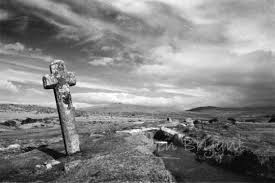
 I do not believe in ghosts at all. As a youngster I think I hoped that they existed, but due to my scientific bent I have short shrift for anything supernatural. This does not mean I don't find it all fascinating: I have a very deep-seated interest in all things ghostly and mysterious, as I feel it tells us a great deal about the human condition. But I never thought I would see a ghost. And the majority of my brain still insists that I haven't. It was a trick of the light, or even an hallucination, asserts the side of my mind most closely aligned with Occam's Razor. Imagine the implication of actually seeing a spectre in my bathroom: it would firstly mean that my flat is haunted and, quite frankly, sod that. Far too stressful. It would also suggest that there is perhaps life after death (if floating meaninglessly in someone else's bathroom is 'life' in any true sense), and this goes against all of my intuition and education. Far easier to say that it was simply a sham - a trick, amplified by my silly brain.
But here's the thing: how easy it was for my brain to be fooled! I would say I am a fairly sensible chap, with a keen sense of scepticism. I always seek out the most realistic and reasoned arguments for or against anything. And yet, last weekend, just a fleeting peep of something strange has led me to wonder what my waking eyes have seen. I think this, in itself, suggests an answer to the big question: what are all these paranormal witnesses seeing. All those thousands of men and women who have seen ghosts, UFOs, the Loch Ness monster, Pikachu and all, all of them have been fooled by their brains. What they saw was something immeasurably dull - a stick, or a cloud of steam, or a little yellow rat - and their brains, their over-evolved, high-perfomance brains, have filled in the rest of the story. The stick becomes an anachronistic plesiosaur, the cloud of steam a baleful spirit and the yellow rat is suddenly a fictional pocket monster from Japan.
Our wonderful brains are flawed. All you need to do to witness this is see a face in the wood-chip wallpaper round your gran's house, or a smiling clown in the pattern of clouds above you. Your brain wants to see things that aren't there, as it is programmed to seek out movement, forms and most importantly faces. All it took was a mote in my eye, or a gust of wind, to fool my brain into seeing ghosts. And, the trouble is, once its in the mind, it's hard to shake the terror...
And this is the other thing at work, of course. Deep inside our psyche is a strange urge to be terrified. We all merrily seek out things that scare us (I watched Lightfields the other night, sequel to the excellent Marchlands, and spent the whole time peering through my fingers, waiting for a terrifying shock that sadly never came), to the point where we create or invent whole scenarios just to freak ourselves out. On a global scale this leads to theme parks and a thriving horror film industry. On an individual basis, this means telling exaggerated creepy stories and adding malign intention to everyday occurrences, like a fugue in a bathroom.
The myriad ghost stories and legends that litter the UK in particular are testament to these dual drives of wanting to be scared and the brain being able and willing to scare us. The endless reports of ghostly figures, hideous demons and frightening alien encounters are, perhaps, all a product of our own fevered imaginations.
Either that, or they're real.
Part II - my favourite 'real' ghost stories:
1. The Brown Lady of Raynham Hall, with her eyeless sockets and habit of floating down stairs. This photo was taken by a photographer for Country Life magazine who was taking a nice shot of the staircase when he noticed this shape descending the stairs:
Saturday, 23 February 2013
Units of work with overarching narratives
The council had decided it. The beautiful village needed a
bypass, and quickly. Deaths on the main
road had been occurring all too often, and it was time to act. Three potential routes were established, and
the villagers quickly decided on the route best for them, their families and
their businesses. Just as the contest
between the routes was getting fierce,
the local vicar was killed in a hit and run incident. There were rumours of murder…
The reasons this unit work so
well are two-fold. One, it embeds
character development into the scheme, giving the students open-ended
opportunity to flesh out their villager, giving them traits, back-stories,
motives and relationships. This leads to
very rich and detailed Speaking and Listening activities, and gives them an
opportunity to add a very strong voice to their writing. Two, it has an over-arching narrative: a
story, that gives all of the written and spoken tasks a distinct purpose and
flavour. Yes, it is a fiction, and I
imagine some would argue that transactional writing in a world of fiction is
meaningless. I would take issue with
this, as the fictional world is grounded in reality and deals with real issues,
but still: there is ample room to create narrative units entirely based in
reality.
So goes the storyline of a KS3
transactional writing/speaking unit of work that I have taught for several
years. Units of work that focus on the
writing of news articles, letters, speeches and the like can be incredibly
boring to teach and to learn from.
Endless lessons of writing different, meaningless letters to imaginary
people can really wear down the motivation of even the happiest students, and
are anathema to those who find school to be an annoyance. I just couldn’t bear to put my students through
this hell, so a few years back I trawled my imagination and dredged my memory
for some way of making a unit of this type fun.
Year 8 English lessons from my own past swam into focus: a village, that
every student is a ‘resident’ of, with careers, social anxieties,
relationships, friendships and deep seated rivalries. This was a unit of work I remembered well,
delivered by my teacher of the time, Mr Fox.
And it was certainly memorable. I
barely remember any peers (apart from close friends) from my school days, but I
certainly remember us all in the drama studio, acting our parts with gusto,
arguing and back-biting about the pros and cons of Bypass Route A. Happy days indeed, so it made eminent sense
to steal this unit, give it some more flourishes and develop it for a full
transactional writing unit.
 |
| The Village - drawn on MS Paint (I'm a masochist). |
So, the story of the village and
its problems provides a backdrop to a range of written and spoken tasks. Travel guides or Wikipedia entries can be
written for the village itself (writing to inform/describe for different
audiences); character biographies can be drafted (writing to entertain and
develop character); newspaper reports and editorials can be written, with a
focus on the difference between certain newspaper types/audiences; even
obituaries and epitaphs, for the poor dead vicar, can be written – it sounds
macabre but the students enjoy trying this formal and prescriptive style for a
change. Spoken tasks can include
speeches from characters about their opposition to council plans; drama
activities based around protests and village hall meetings; full on debates,
even. There’s plenty of scope for
elongating or shortening the unit as you see fit. I found myself adding a sub-plot about finding old manuscripts in the ancient cottage - this involved the class decoding and creating a cohesive storyline from a differentiated range of renaissance-18th Century text excerpts. This acted as a pleasant taster for the next term's unit of work - Twelfth Night.
The students love it, of
course. It’s very engaging, but
obviously this isn’t the be-all and end-all. They
learn an awful lot, too. With their defenses down, they absorb the skills and knowledge quickly, as it all makes more sense, with their writing linked to a central narrative. It all means something, and adds to the overall story. They can
follow their tasks through, recognising that writing a sub-par news report on
the Vicar’s death would show a lack of respect, and would not be print-worthy. They make their editorials truly powerful and persuasive, as they really want a certain by-pass route to be successful. Thus, their learning and practice of
technical aspects, such as punctuation, leap in quality. It’s astonishing how ‘real’ the whole thing
can become, to the point where the students end up leading the narrative,
taking it to strange new places. For
example, we ended up doing some creative writing based on animals being
displaced from their homes. A pupil had
chanced upon an old episode of Animals of
Farthing Wood and wanted to use it.
And it worked brilliantly, with excerpts from Wind in the Willows analysed, and the whole theory and technique of
anthropomorphism explored.
Creating story-driven schemes is time-consuming, but very rewarding. I aim to storify all of my KS3 units in this way - I'm currently sorting out a First World War unit where the progress of the war is tracked by poetry and the biographies of Sassoon and Owen - and I believe that this will create English lessons that will be remembered for a long time. There are limits, of course. It would be unfeasible to create a narrative line in some units, I'm sure - but be imaginative. Media units or transactional writing units can always be given a narrative (I have a Yr 9 writing unit built around the story of a decaying amusement park), and poetry units should be given some kind of central focus or tenet. Novel and play units have their own narrative, of course, and I feel any persuasive module, either spoken or written, should have a story or major project at its heart.
Creating story-driven schemes is time-consuming, but very rewarding. I aim to storify all of my KS3 units in this way - I'm currently sorting out a First World War unit where the progress of the war is tracked by poetry and the biographies of Sassoon and Owen - and I believe that this will create English lessons that will be remembered for a long time. There are limits, of course. It would be unfeasible to create a narrative line in some units, I'm sure - but be imaginative. Media units or transactional writing units can always be given a narrative (I have a Yr 9 writing unit built around the story of a decaying amusement park), and poetry units should be given some kind of central focus or tenet. Novel and play units have their own narrative, of course, and I feel any persuasive module, either spoken or written, should have a story or major project at its heart.
Sunday, 10 February 2013
Ofsted Report: Hogwarts School of Witchcraft and Wizardry
Inspection Judgements:
The Achievement of Pupils is Satisfactory.
Pupils at Hogwarts have access to a reasonably wide range of esoteric qualifications, suited to its key demographic. As an independent school, it does not have to follow the National Curriculum closely; however, it is disappointing to note that basic requirements such as English, Mathematics and Religious Education are all lacking or entirely missing from the school's syllabus. This has had adverse effects on all students, many of whom have never even been taught basic KS1 or 2 literacy. A few students have attended state or independent primary schools, and these students typically perform very well in contrast to their peers.
The majority of students appear to be under-performing, with most pupils struggling in all their lessons, most of which appear to be set at too challenging a level. One particular class, which seemed to be based on A-Level chemistry, proved too difficult for even the most proficient students. Only one pupil managed to complete the lesson objectives, mainly thanks to his use of an annotated text book. However, certain subjects appear to be either very short-term, or far too easy for the majority of students. An outdoors lesson was observed where students made very little progress over several lessons, simply performing the same repetitive tasks again and again, counting and feeding small maggot-like creatures. Clearly the curriculum requires an overhaul to bring literacy and numeracy levels up to the appropriate level for such a prestigious establishment.
Extra-curricular activities are well-established at the school, with chess clubs, animal care groups and 'duelling clubs' all vying for popularity. There is a definite sense of social responsibility among some students, with evidence of a student-led campaign to get the canteen workers more breaks and holiday time. The school library is underused, and often totally empty. The librarian has no idea why this is the case.
The sixth form is indistinguishable from the main school, as the students all remain on to study to the age of eighteen. The subjects offered remain the same, though with more rigorous examinations. End of KS4 results are generally average, whereas end of KS5 results this year were disrupted by unforeseen and external events. Students typically go into government posts, journalism or remain unemployed.
The Quality of Teaching is Unsatisfactory
Teaching at Hogwarts is generally very old-fashioned and lets the students down considerably. Lessons are formulaic and, other than the occasional impressive display of skills from teaching staff, are dull and lifeless. Lessons all too often revolve around tedious rote-work and use of text books. The study of History is particularly poor, with very little teacher interaction and no group work of any kind. Students were frequently found to be asleep during these lessons and, on one occasion, the teacher was also sleeping at their desk. Clearly this is not good enough, and suggests that Senior Leadership need to have far more rigorous CPD in place for struggling teachers, alive or dead.
Teachers have very high expectations of their pupils - often far too high for their age and ability. Again, during chemistry, the teacher was seen to display entirely unfounded expectations of a Year 7 class who could barely keep up with his description of various chemicals, poisons and antidotes. Students in this class were often punished for their lack of prior knowledge - a worrying trend that the senior leaders of the school need to counter as soon as possible.
Assessment for Learning is not well implemented at Hogwarts school. In fact, students seemed only rarely to be given assessments of any kinds, and homework tasks are often over-long and irrelevant (usually essay based). Starters and plenaries are very rare, and usually students enter classrooms with a genuine fear of what they may be expected to achieve. Tasks within lessons are often over-long and repetitive, lacking anything other than brief modelling from the teacher. Lessons all appear to be two hours long, but it is hard to say exactly what fills this time, with lessons often dedicated to a single activity with little teacher feedback beyond simple criticism. As such, the pace of learning is very slow in most subjects - most notably chemistry, biology, PE (which seems to disappear after Year 7) and charms.
The Behaviour and Safety of Pupils is Unsatisfactory
Frankly, the quality of safety provision for students at Hogwarts is totally unacceptable. Despite having a highly qualified, capable and over-worked school nurse, many severe and significant injuries have occurred in recent years. The main sport played by the school, entirely internally, is incredibly dangerous and should be reviewed by the HSE immediately. Several injuries from wildlife have occurred in recent months, with trees and large flying animals usually to blame - these hazards are not successfully monitored or kept safe by any member of staff other than the groundsman. This kind of Health and Safety brief is not usually in the remit of a groundskeeper, and it is our recommendation that more staff are drafted in to help with this task. There have been several deaths in recent years, all on site. The recent loss of the previous headteacher was a severe blow to the school's reputation, and many parents have removed their children from the premises. The headmaster's death went entirely unexplained, though rumours that a pupil murdered him are almost certainly hyperbole. The death of a Year 12 student during an international competition was also kept from the newspapers, and the effects are still being felt across the school. This summer, the school was disrupted by riots and pitched battles between rival sectors of the community. Whether the school was an incidental victim of this outburst of aggression, or an active part of it, is unknown to the inspectors. Significant damage was wreaked on the school buildings, with certain wings now closed for repairs. In short, at present Hogwarts is a very unsafe environment for all students and staff.
Behaviour of students is very poor indeed. Staff seem to maintain their grip on the school using threats of violence, and yet student disruption is at high levels. Most of the worst behaviour seems to be focused around one particular 'house' within the school's pastoral system, but despite this clear correlation, no positive action has been taken. Bullying is a very common occurrence and is not dealt with very well by the pastoral team, which consists of some of the strictest staff members in the school. Often the bullying between students can become physical aggression very quickly, with some students causing each other actual bodily harm. The bullying of students by staff is at unacceptable levels, with some students singled out from an early age for grudges that seem to date back decades. Most of these issues stem from the high levels of insular relationships that form in the school, between staff and pupils. Much of this stems from the unsatisfactory usage of a house system, which seems only to make the students more insular. Cross-house friendships are very rare and often mocked by other students, and even staff. One house in particular seems to be very isolated, with students from all other houses declaring them 'evil', 'sly' and other derogatory terms; with a common room located in a cold and damp basement, and a Head of House who spends a great deal of time out of school, it is perhaps no surprise that the students are struggling. Looking at the records, the House Championship has been corrupt for some time, with clear preferential treatment given to some houses over others.
The Leadership and Management of the school is Satisfactory
Until his death, the previous headteacher had a very strong reputation in the local community and had steered the school through some difficult times. However, accusations of favoritism dogged his career, and his lack of investment in quality teaching led to some very poor staff choices, including the appointment of unskilled staff for Divination (a spurious subject that has no academic rigour) and the constant poor selection of teachers for the difficult role of Defence Against the Dark Arts (a PSHE subject). After the headteacher's death, the school was run by the Chemistry teacher, rather than the established deputy. The reasons for this are unclear, but it is certain that it had a detrimental affect on the school and its students, many of whom were impossible to locate during our time at the school, suggesting serious problems with the school's safeguarding procedures. Since the death of the last headteacher, there has been no clear line of authority for child-protection matters, with the issue usually left to arcane and vague concepts such as 'love' and making sure students are 'sent to live with relatives until the age of 17' to keep them 'safe'. Middle management is a tier that seems not to exist, with the headteacher taking sole responsibility over every aspect of the school. This is not an efficient model, and it is recommended that the school create a new tier of management to help the current headteacher with her workload.
Hogwarts School is awarded a grade of 4 (unsatisfactory)
 Buy me a coffee!
The Achievement of Pupils is Satisfactory.
Pupils at Hogwarts have access to a reasonably wide range of esoteric qualifications, suited to its key demographic. As an independent school, it does not have to follow the National Curriculum closely; however, it is disappointing to note that basic requirements such as English, Mathematics and Religious Education are all lacking or entirely missing from the school's syllabus. This has had adverse effects on all students, many of whom have never even been taught basic KS1 or 2 literacy. A few students have attended state or independent primary schools, and these students typically perform very well in contrast to their peers.
The majority of students appear to be under-performing, with most pupils struggling in all their lessons, most of which appear to be set at too challenging a level. One particular class, which seemed to be based on A-Level chemistry, proved too difficult for even the most proficient students. Only one pupil managed to complete the lesson objectives, mainly thanks to his use of an annotated text book. However, certain subjects appear to be either very short-term, or far too easy for the majority of students. An outdoors lesson was observed where students made very little progress over several lessons, simply performing the same repetitive tasks again and again, counting and feeding small maggot-like creatures. Clearly the curriculum requires an overhaul to bring literacy and numeracy levels up to the appropriate level for such a prestigious establishment.
Extra-curricular activities are well-established at the school, with chess clubs, animal care groups and 'duelling clubs' all vying for popularity. There is a definite sense of social responsibility among some students, with evidence of a student-led campaign to get the canteen workers more breaks and holiday time. The school library is underused, and often totally empty. The librarian has no idea why this is the case.
The sixth form is indistinguishable from the main school, as the students all remain on to study to the age of eighteen. The subjects offered remain the same, though with more rigorous examinations. End of KS4 results are generally average, whereas end of KS5 results this year were disrupted by unforeseen and external events. Students typically go into government posts, journalism or remain unemployed.
The Quality of Teaching is Unsatisfactory
Teaching at Hogwarts is generally very old-fashioned and lets the students down considerably. Lessons are formulaic and, other than the occasional impressive display of skills from teaching staff, are dull and lifeless. Lessons all too often revolve around tedious rote-work and use of text books. The study of History is particularly poor, with very little teacher interaction and no group work of any kind. Students were frequently found to be asleep during these lessons and, on one occasion, the teacher was also sleeping at their desk. Clearly this is not good enough, and suggests that Senior Leadership need to have far more rigorous CPD in place for struggling teachers, alive or dead.
Teachers have very high expectations of their pupils - often far too high for their age and ability. Again, during chemistry, the teacher was seen to display entirely unfounded expectations of a Year 7 class who could barely keep up with his description of various chemicals, poisons and antidotes. Students in this class were often punished for their lack of prior knowledge - a worrying trend that the senior leaders of the school need to counter as soon as possible.
Assessment for Learning is not well implemented at Hogwarts school. In fact, students seemed only rarely to be given assessments of any kinds, and homework tasks are often over-long and irrelevant (usually essay based). Starters and plenaries are very rare, and usually students enter classrooms with a genuine fear of what they may be expected to achieve. Tasks within lessons are often over-long and repetitive, lacking anything other than brief modelling from the teacher. Lessons all appear to be two hours long, but it is hard to say exactly what fills this time, with lessons often dedicated to a single activity with little teacher feedback beyond simple criticism. As such, the pace of learning is very slow in most subjects - most notably chemistry, biology, PE (which seems to disappear after Year 7) and charms.
The Behaviour and Safety of Pupils is Unsatisfactory
Frankly, the quality of safety provision for students at Hogwarts is totally unacceptable. Despite having a highly qualified, capable and over-worked school nurse, many severe and significant injuries have occurred in recent years. The main sport played by the school, entirely internally, is incredibly dangerous and should be reviewed by the HSE immediately. Several injuries from wildlife have occurred in recent months, with trees and large flying animals usually to blame - these hazards are not successfully monitored or kept safe by any member of staff other than the groundsman. This kind of Health and Safety brief is not usually in the remit of a groundskeeper, and it is our recommendation that more staff are drafted in to help with this task. There have been several deaths in recent years, all on site. The recent loss of the previous headteacher was a severe blow to the school's reputation, and many parents have removed their children from the premises. The headmaster's death went entirely unexplained, though rumours that a pupil murdered him are almost certainly hyperbole. The death of a Year 12 student during an international competition was also kept from the newspapers, and the effects are still being felt across the school. This summer, the school was disrupted by riots and pitched battles between rival sectors of the community. Whether the school was an incidental victim of this outburst of aggression, or an active part of it, is unknown to the inspectors. Significant damage was wreaked on the school buildings, with certain wings now closed for repairs. In short, at present Hogwarts is a very unsafe environment for all students and staff.
Behaviour of students is very poor indeed. Staff seem to maintain their grip on the school using threats of violence, and yet student disruption is at high levels. Most of the worst behaviour seems to be focused around one particular 'house' within the school's pastoral system, but despite this clear correlation, no positive action has been taken. Bullying is a very common occurrence and is not dealt with very well by the pastoral team, which consists of some of the strictest staff members in the school. Often the bullying between students can become physical aggression very quickly, with some students causing each other actual bodily harm. The bullying of students by staff is at unacceptable levels, with some students singled out from an early age for grudges that seem to date back decades. Most of these issues stem from the high levels of insular relationships that form in the school, between staff and pupils. Much of this stems from the unsatisfactory usage of a house system, which seems only to make the students more insular. Cross-house friendships are very rare and often mocked by other students, and even staff. One house in particular seems to be very isolated, with students from all other houses declaring them 'evil', 'sly' and other derogatory terms; with a common room located in a cold and damp basement, and a Head of House who spends a great deal of time out of school, it is perhaps no surprise that the students are struggling. Looking at the records, the House Championship has been corrupt for some time, with clear preferential treatment given to some houses over others.
The Leadership and Management of the school is Satisfactory
Until his death, the previous headteacher had a very strong reputation in the local community and had steered the school through some difficult times. However, accusations of favoritism dogged his career, and his lack of investment in quality teaching led to some very poor staff choices, including the appointment of unskilled staff for Divination (a spurious subject that has no academic rigour) and the constant poor selection of teachers for the difficult role of Defence Against the Dark Arts (a PSHE subject). After the headteacher's death, the school was run by the Chemistry teacher, rather than the established deputy. The reasons for this are unclear, but it is certain that it had a detrimental affect on the school and its students, many of whom were impossible to locate during our time at the school, suggesting serious problems with the school's safeguarding procedures. Since the death of the last headteacher, there has been no clear line of authority for child-protection matters, with the issue usually left to arcane and vague concepts such as 'love' and making sure students are 'sent to live with relatives until the age of 17' to keep them 'safe'. Middle management is a tier that seems not to exist, with the headteacher taking sole responsibility over every aspect of the school. This is not an efficient model, and it is recommended that the school create a new tier of management to help the current headteacher with her workload.
Hogwarts School is awarded a grade of 4 (unsatisfactory)
Buy me a coffee!
Saturday, 9 February 2013
Science on the Telly
Hurrah for Sir David Attenborough. In a benighted world, he still calmly
presents the facts of life in his wonderfully honest and sincere voice (easily
the nicest voice in the world, after perhaps Ian McKellen’s Gandalf). This is good, as the rest of the telly-world
seems bent on providing mis-information, dogma and foolishness. ‘Science’ is the abstract noun that gets the
most punishment. For whatever reason,
the realm of science is treated as just that by the media – a fairytale
kingdom, unknowable to the masses, and only really comprehended by a lucky few
who possess the magical properties required, like jumping into an enchanted
lake or breaking the back off a wardrobe.
‘Science’ is a mystery, a bizarre concoction that seems to consist of
huge, blinking machines, intimidating men and women wearing goggles and looking
stern, huge explosions and Brian Cox.
Nowhere was this more apparent than in a recent episode of The Year of Making Love – a deeply
misguided TV ‘experiment’ that attempts to prove that ‘science’ can match
people up and make them fall in love.
Now, at first glance I thought this meant they would take people’s
initials, plonk them on the periodic table and set them up that way (‘So,
Annette Goon – you’re paired up with Alec Umbrella, and what a beautiful sight
they are together!’). But no. The ‘science’ that is so mystically invoked
by the utterly unlikeable Cherry Healy is, in fact, a few questionnaires,
compiled by a couple of boffins who calculate what people’s hobbies are, and
match them up that way. If this is
science, then so is putting forks in the correct section of your cutlery
drawer. There was nothing remotely
scientific about the approach taken in the programme. There was no concern at all about the
incredible number of variables at work in this experiment, or the terribly
subjective nature of the ‘scientists’, who shrieked happily whenever a couple
were first introduced: “Ooh look, they’re smiling! They’re going to get on just
fine; oh, these don’t look happy – look, he’s not impressed by her webbed
fingers at all – this won’t end well”.
Hardly an unbiased observation.
The impact of having a camera crew slavishly follow these poor
singletons on their dreadful dates
wasn’t considered at all. I
always thought science was about minimising the intrusion of the observer;
having a camera lens right in your face when trying to enjoy crème brulee in a
gastropub with someone you’ve just met doesn’t really suggest CERN levels of
scientific rigour when testing their likelihood of getting all sexy.
But I could put up with all of this foolishness if the
programme didn’t keep insisting it was all deeply ‘scientific’. It got so deluded that it put me in mind of a
crazed drunkard sobbing that he is really sober, whilst miserably urinating all
over his duvet and staring, teary- and bleary-eyed at a photo of his dead
dog. ‘Remember’, Healy says, ‘that
science has put these two together’.
Even the pudding-faced contestants kept insisting that their romantic
successes and failures were all down to ‘science’, as if this was simply the
name of the lead researcher. Perhaps it
is.
Hearing it so often ends up having a powerful effect. There will be people who believe that it has
now been proven, beyond reasonable doubt, that science can hook people up. To
most, this will suggest that potions, or weird blinking machines can act as
cupid. They will take this
misapprehension to the grave. Yes
indeed, it’s fine when it’s about something as ephemeral and pointless as this
TV programme, but when the same thing occurs with science that matters, such as
inoculation or nutrition (read anything
by Ben Goldacre to find out just what kind of egregious misinformation is out
there) then we surely have to blow the whistle and demand that science is taken
more seriously. Surely?
People could argue that Brian Cox is the perfect saviour of
this grim situation, but I would have to disagree. His new series, Wonders of Life, is an exploration of biology by a physicist - odd
and not altogether helpful, but then what do I know? Maybe cross-discipline stuff is all the rage
now. Maybe I should start designing
skyscrapers or performing brain surgery for a giggle. But my real problem with this show is the
man himself. He's being hailed as the
natural successor to both Attenborough and Patrick Moore. How dare these faceless folk suggest such a
thing? If Brian Cox ends up 'replacing'
Attenborough once he's gone (after what I hope would be the most wonderfully extravagant
and beautiful state funeral humanity has ever seen) then I will set fire to my
television and sit in a corner, grumpy, for the rest of my life. He's just too there. Here's a zebra, look
at it's pretty stripes and happy face.
But wait, Brian Cox is standing right in front of it, gurning and
bubbling like a moron about how awesome it all is. Too much effervescence, too little
information and far too much of Brian Cox's face. Attenborough only rarely pops up to speak to
us face-to-face, and that's the right way to be. Cox just can't get enough of his own teeth on
TV, and that's to our detriment.
We need proper, informative, classy science shows on the TV;
all else is just fluff.
Tuesday, 5 February 2013
The Haunted Asda
Residents of a suburb of Gubley are astonished this week
with the revelation that their local supermarket is haunted. The Asda store on
Great Fleshy Road has been plagued with a myriad of reportings of ghosty
occurances over the last few weeks. It
would seem that ghosts have been seen, heard and even smelt in the warehouse
area, the canteen, and the area round the big bins.
Batch Loaf
The first ghostly sighting was in November of last
year. Asda employee Jessie Cake had been
hosing down the counters late on a Thursday night when he heard the
unmistakable sound of a large unseeded batch loaf falling to the floor. Cake (24) had rushed to the source of the sound
and seen something incredible: “It was just this huge thumb,” he cries. “It was slowly thumbing through the different
loaves of bread, as if it were somehow trying to choose between them.” Cake had run straight to the boss’s office
to report his sighting, but fell foul of his own hose, cracking his skull
on the sluice. He was found the next
day, and recounted his story to horrified onlookers.
Managers have stated that ghostly sightings, of thumbs or
otherwise, do not fit under normal Health and Safety laws, and that the case
with Mr. Cake is still under review. His
store manager assured us that he would be able to return to work as soon as his
instep was healed.
Mysterious Cloud
This should have been enough to close the store, but
short-sighted bosses demanded that the store remain open to the public. The second sighting came soon afterwards. Security guard Andy Hornbill had been
watching the rear entrance when he saw a mysterious cloud heading towards him:
“It were right weird. I was standing and
looking at the shutters when this cloud of mist came at me like a fox and made
me worried. It had no hands but it
seemed to have thumbs that were threatening me.
It came right near the bailer and then disappeared by the gas
taps.” Hornbill (40) had been bewildered by
the encounter, but was most shocked by the smell left behind by the entity: “it
were like dirty rubber plimsolls” he opined, grimacing at the memory, “but not
the right kind – the wrong kind.”
Without So
Clearly there was something nefarious at work here. The Asda store occupies the site of an old
tyre factory and broom warehouse. These
were demolished soon after being sold to the Asda parent company, Walmart, and
indeed some employees believe there was something fishy going on here. Aging coffee shop customer Agnes Pinecone (67) believes that there were plottings afoot: “It just seems strange that as soon
as they bought them buildings, they go knocking them down without so much as a
second thought. What were they hiding
from us? Then they go building an Asda right on the top of the, no repect or
owt for what was there before. I tell
you, it’s no wonder there’s summat going on in that place.” The mystery has been compounded by the discovery of a broom in a cubby-hole in the gent's changing room. No-one has as yet explained why it should be there, or why it has such a mucky handle.
Thumbs
The ghostly smell has been smelt several times since Mr.
Hornbill experienced it for the first time, and always somewhere around the
bailer. As for the ghostly thumbs, they
haven’t been seen since. Some say they
are waiting for the right moment to strike.
Others say they were just thumbs.
All we know, here at the Herald and Jerkin, is that there’s something
sinister over on Great Fleshy Road.
Friday, 1 February 2013
On Tallness
I am quite a tall person – roughly as tall as a garden wall,
or a little shorter than a ceiling. I
duck under doors and get cooed over by old ladies in chip shops. It is a good thing, a lot of the time.
Being tall is a permanent state of being, of course. This
means that I have always seen the world through the eyes of a tall person, as I
can’t really remember any times prior to being around 13 in any meaningful
detail. To me, an eye-line at roughly 6’4”
is the norm, and my perception of the world hangs upon it. After all, tall people get a unique view of
the world, much like worms or fleas do. We see the hidden places – the places
where people put things to forget about them, areas in towns where no graffiti
has been daubed, spaces over and above things where secrets lie. I can see the top of the lockers at school,
for example. Fascinating hoards of
miscellany can be discovered there – old pens, bits of paper, ragged lumps of
food, mouldering old doughnuts. They all
inhabit this dead zone where no normal people visit. They belong there. The tops of vans are equally intriguing. Rarely seen by human eyes, apart from those
souls that linger on motorway service station skyways, they offer a fascinating
glimpse of the unknown: there is nothing
particularly to see, you understand; it’s more that you are glimpsing virgin
territory when you look at the roof of a transit van.
The deep recesses in train’s over-head shelves can’t escape
my gaze, and nor can top shelves.
Top-most shelves are always the best of all. That’s where we put all of our least wanted
paraphernalia – things we can’t quite do away with, but things we don’t want to
consider in a meaningful sense. It is a
relegation zone far more potent than the bottom shelf (that’s where we put our
guilty pleasures), and yet I see them in every house I visit. As a fan of the forgotten and abandoned,
these bleak spots are an endless source of fascination – a top shelf filled
with books offers a glimpse into the psyche of an individual that years of
intimate friendship cannot beat. A shelf
lined with dusty ornaments and trinkets paints a picture of a long life of endless
unwanted Christmas presents, and their associated cocktail of emotions: guilt, disappointment and fury. A top shelf of records points to a careless
obsessive, a nostalgic clutz clutching his vinyl, but no longer interested in
ever playing it again. To tall people,
this is all on display. Beware ever
inviting a tall person into your home.
But height is not always a blessing. Often it causes pain, discomfort, a certain
sense of injustice. In the same way as a
world designed for people of average height affords us illicit joys, so too it
can ruin our day. Washing dishes is a
painful chore, marked with tremendous pain in the lower back and
shoulders. The pots and pans are far
away, you see. Manhandling them is
tiring, especially when bent-double over the sink. My head is so used to being whacked into
things that it no longer hurts when I do.
Rather than a searing jolt of pain when I crack the top of my head on
the hood of the oven, I get a mild tickling sensation, twinned with a quizzical
glance around the vicinity. I’m
confident that if someone shot me in the head I would simply give it a quick
rub and move on. Food is a constant
issue for the very tall, too. Calorie
intake is around 3500-4000, and this can be expensive. Vast piles of pasta, whole pizzas, massive
steaks and whole gallons of water can be a very pricey breakfast. The trouble is that for someone around 6’7”
to lift their arm to take a sip of coffee requires so much more energy! My left
arm weighs around the same as a chest of drawers, and my legs weigh as much as
three times this amount. It’s a
wonder I get around at all.
So, next time you see a freakishly tall person, consider
their lives. Think about all the strange
things they’ve seen, and pity their pained, endlessly hungry lives.
Sunday, 27 January 2013
Punctuation Pets on Paper!
Here's my first attempt at properly drawn Pets, without the aid of a computer. They look a bit different, but I'm sure that;'s just teething problems. I've created a new Comma, to replace the derivative and boring caterpillar thing - he's much more fun.
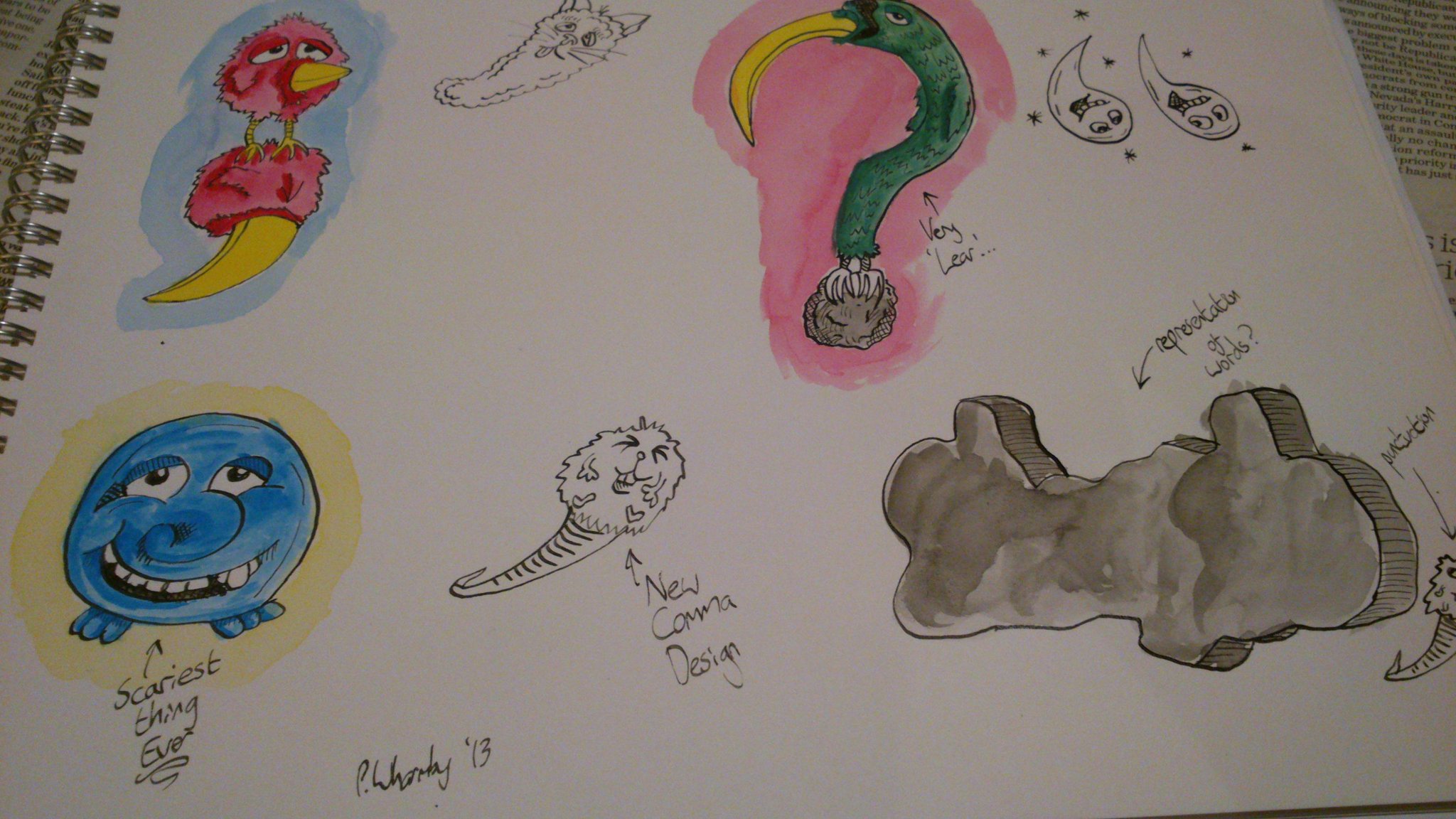 Let me know what you think!
Sunday, 20 January 2013
Commas
What is it with commas? At first glance they appear to be an easy-to-understand branch of the punctuation tree; a straightforward mark that only the worst dunces can possibly mess up. This is certainly the attitude that my students have for this poor, misunderstood piece of typography. 'We learned how to use commas in year 2,' they cry in unison, 'we need no more instruction in this barren mark.' They then proceed to merrily splice their way through their work, like Dr. Moreau.

Lists they understand. This is the one punctuation mark that they are supremely confident of, and rightly so. The problem is that lists feature very lightly in work written post KS2 - they are not a common sight in your average essay or film review. So their happiest times with commas are removed from them, and they are left, arrogantly flailing, in a morass of misunderstood rules and commas after connectives. The poor devils. Recently I've made punctuation my life's work, or so it seems. I spend a great amount of my time trying to find ways to engage students in it, and also instruct them as to their use. And this is tricky, as the rules are convoluted and time-consuming, and yet I find I cannot just fob them off. I can't say to a class that commas are where you breathe. I just can't. The main reason for my truculence on the matter is because simplistic rules like this don't work and lead to terrible misapprehensions. No, it's much better to teach them exactly how punctuation works, so they can cope with any eventuality.
With semi-colons and full stops this is an achievable aim. I can even get apostrophes into their eager little heads with some ease. But commas give me nightmares. Their rules are seemingly simple, but getting them across to students is incredibly hard. Let's start with the subordinate clause and its associated comma. In order to teach students this, they have to grasp the concept of a subordinate clause. This also means they have to understand the concept of 'sentence'. Have you asked a student what a sentence is recently? If not, give it a go. It's a hoot. And the trouble is, how does one define a sentence in easy-to-grasp language? It is a single unit of meaning? What's meaning? It's a single utterance formed around a verb? God help us - what's a verb again? It's a penguin? Yes. It's a penguin. A single, functioning, happy penguin. That'll do. And this is what I use to get across the whole spectrum of sentences, compounds and complexes. Three penguins in various states of disarray:
Simple sentence = a penguin, happily standing there. He's perfectly all right by himself and cannot be broken down any further. He makes sense, too.
Compound sentence = a penguin with another fully-functioning penguin glued to his back. They both look a bit miffed. They are glued together by the fabled 'Andorbut' glue. So far so mental.
Complex sentence = a penguin wearing a pair of robotic trousers. This is a penguin that has an optional upgrade. The upgrade cannot work alone, of course. No - it needs to living, breathing, functioning penguin to operate. The little seat the penguin sits on is in the shape of a comma.

So, there we are. The compexity of the issue demands bizarre analogies to be formed. Now, it's altogether possible that I've missed a trick here, and that there is some easy way of teaching this without resorting to zoo animals. If so, let me know.
But still, commas and subordination. Tricky.
What about commas and connectives? Pretty easy this, as long as they remember it's comma before connective. Even then, many will get confused why 'and' is exempt from this rule, and whether the writing after 'because' is a subordinate clause or not. For me it all boils down to the 'survival' idea - if a section of text can survive alone, and cannot be broken down into a shorter unit of meaning including a verb, then it's a sentence.
Then we have the splice. I've been reduced to strange analogies again when it comes to this most egregious of punctuation errors. My line with the students is that putting a comma between two full sentences (penguins or whatever) is barbaric. It just can't cope with the pressure and will be squashed flat. They like this idea. I tell them that the only marks strong enough to handle are semi-colons and full stops. Then one smart-arse will pipe up, 'but what about exclamation marks?' Yes, those too. This works pretty well, especially if I draw dead little commas all over their work when I see any splicing going on (I haven't actually done this yet, but I sure am going to start now).
But even with this arsenal of weird ideas, I still don't feel I've got a complete handle on their comma ability. There must be other ways to achieve full comma-ability - any ideas?
Saturday, 19 January 2013
Books that I'd like to teach
When it comes to teaching literature we all have our favourites: books that we have taught many times and feel incredibly comfortable with. Take you pick from the list: To Kill a Mockingbird, Of Mice and Men, The Crucible, An Inspector Calls, Death of a Salesman, Romeo and Juliet, Stone Cold, Touching the Void, The Great Gatsby etc etc.
But what of those books that we love, but feel we are not allowed to teach? GCSEs and A-Levels seem to have harsh strictures on what we can deliver to students, and often this forces our hand away from gems that we've loved for decades, books that we know inside out, books that we could teach to a busload of Millwall fans without losing their interest. Perhaps we need to make a change here and take a few literary risks. After all, GCSEs and A-Level syllabuses are more flexible than they seem these days, and there's always KS3...
I remember teaching The Curious Incident of the Dog in the Night Time to a Year 8 class several years ago, when I was an Independent school drone. It was on the Year 8 syllabus, which surprised me (there's a wheelbarrow-load of bad language in that books, including the c-bomb), and so I built a tidy little scheme around it. Goodness, but their attitude to the book was incredible. I've never taught a text that has been so eagerly, so immediately lapped up as this one. Once we'd established the salient facts about the narrator, Christopher - most importantly the nature of his Aspergers - the students understood everything, even the necessity for all the swearing. It gave them an insight into authorial choices and intentions which set them up for the rest of the year. It even gave them a chance to understand the term 'post-modern', which they guzzled up with relish. So much enjoyable teaching and learning from a book that doesn't typically feature on school syllabuses must give us pause for thought. Perhaps it's time to cast off the shackles of the tried and tested, and find ways to teach books we're really passionate about?
So, what would I teach, if I could?
1. Alice's Adventures in Wonderland (KS3-5)
My all time favourite book, and with enough content and style to keep you busy for months, Wonderland is a perfect book for teaching. The manipulation of language alone is going to help students grasp connotation and emotional impact, and the episodic structure of the story will aid with that tricky side of things too. Characterisations are many and varied, and the humour will draw in even the most grumpy student. I'd probably teach Looking Glass too, mainly because it contains 'Jabberwocky' and Humpty Dumpty, whose meeting with Alice could be analysed for years - 'There's glory for you!' A whole term spent on this book in Year 8, perhaps, could be very useful indeed, paving a way for later understanding about language, structure and form. And Year 8 can be adapted as we wish, so it's simply a case of buying the books (the biggest sticking point) and coming up with a detailed and relevant MTP.
2. The Devil's Dictionary (KS5)
Ambrose Bierce's fascinating and hilarious spoof dictionary would be great in any of the Englishes at KS5. It has a really savage humour that could be a great focus for English Language, and its status as a work of literature can raise interesting questions regarding the nature of literature. Bierce's biography is enthralling, too - especially his disappearance in 1913, where he set off to Mexico (at the age of 71) where he joined Pancho Villa. He was never heard of again. The potential for this to be used at KS5 is huge, thanks to the non-prescriptive nature of certain units on all English courses. Perhaps as inspiration for coursework in Lit Lang, or as an example of language change in Language A2? This could easily find its place into a curriculum. And by the way, if you haven't already, make sure you read it!
3. The Waves (KS5)
I've waxed over-lyrical about this before on here, but it's worth reiterating. The Waves is an enormously important book. The structure is very simple - a narrative separated into times of day by short descriptions of a beach at dawn, midday, dusk etc. But the narrative held within this is very complex and abstract, charting the lives of several children as they pass through time, with traits, utterances and images carried through their whole life. The self-awareness of the characters, and the fact they speak with the forced formality of a witness in the dock throughout the book, describing their lives, have stayed with me for years. A-Level literature students would have a field day.
4. Lucky Jim (KS4)
Kingsley Amis' best book, in my opinion. This would be a great text to read with a year 10-11 class. The difficulty of the relationships and the sad heroism of Jim himself would appeal to a teenage audience. In fact, Jim's open insolence and hatred of all forms of authority in his job as lecturer would strike a chord with most students! The fact that we can't help but root for the poor guy helps too. The problem is, despite its quality and relevance, there is no easy way to fit it into a GCSE course. It isn't a different culture text, and doesn't really fit into literary heritage either. So its left out in the cold. A shame.
5. A Confederacy of Dunces (KS4-5)
This is a tricky book, but the characterisation of the lead character is worth its weight in gold.
Ignatius J. Reilly is the modern teenager. Any student who moans about the world, believing themselves to be better than all others, whilst gorging themselves on pringles playing Call of Duty, would see themselves reflected in this text, and that has to be a good thing. Again, the contextual details surrounding John Kennedy Toole's suicide and subsequent posthumous publication would add fascinating flavour to it. It's a different culture text, at least, but you'd have to be creative with the Controlled Assessments to squeeze it into a GCSE curriculum.
I'll have a think about more as the week progresses. But there we go, a few books that I would love to teach. Now I just have to figure out where, why and how.
But what of those books that we love, but feel we are not allowed to teach? GCSEs and A-Levels seem to have harsh strictures on what we can deliver to students, and often this forces our hand away from gems that we've loved for decades, books that we know inside out, books that we could teach to a busload of Millwall fans without losing their interest. Perhaps we need to make a change here and take a few literary risks. After all, GCSEs and A-Level syllabuses are more flexible than they seem these days, and there's always KS3...
I remember teaching The Curious Incident of the Dog in the Night Time to a Year 8 class several years ago, when I was an Independent school drone. It was on the Year 8 syllabus, which surprised me (there's a wheelbarrow-load of bad language in that books, including the c-bomb), and so I built a tidy little scheme around it. Goodness, but their attitude to the book was incredible. I've never taught a text that has been so eagerly, so immediately lapped up as this one. Once we'd established the salient facts about the narrator, Christopher - most importantly the nature of his Aspergers - the students understood everything, even the necessity for all the swearing. It gave them an insight into authorial choices and intentions which set them up for the rest of the year. It even gave them a chance to understand the term 'post-modern', which they guzzled up with relish. So much enjoyable teaching and learning from a book that doesn't typically feature on school syllabuses must give us pause for thought. Perhaps it's time to cast off the shackles of the tried and tested, and find ways to teach books we're really passionate about?
So, what would I teach, if I could?
1. Alice's Adventures in Wonderland (KS3-5)
My all time favourite book, and with enough content and style to keep you busy for months, Wonderland is a perfect book for teaching. The manipulation of language alone is going to help students grasp connotation and emotional impact, and the episodic structure of the story will aid with that tricky side of things too. Characterisations are many and varied, and the humour will draw in even the most grumpy student. I'd probably teach Looking Glass too, mainly because it contains 'Jabberwocky' and Humpty Dumpty, whose meeting with Alice could be analysed for years - 'There's glory for you!' A whole term spent on this book in Year 8, perhaps, could be very useful indeed, paving a way for later understanding about language, structure and form. And Year 8 can be adapted as we wish, so it's simply a case of buying the books (the biggest sticking point) and coming up with a detailed and relevant MTP.
2. The Devil's Dictionary (KS5)
Ambrose Bierce's fascinating and hilarious spoof dictionary would be great in any of the Englishes at KS5. It has a really savage humour that could be a great focus for English Language, and its status as a work of literature can raise interesting questions regarding the nature of literature. Bierce's biography is enthralling, too - especially his disappearance in 1913, where he set off to Mexico (at the age of 71) where he joined Pancho Villa. He was never heard of again. The potential for this to be used at KS5 is huge, thanks to the non-prescriptive nature of certain units on all English courses. Perhaps as inspiration for coursework in Lit Lang, or as an example of language change in Language A2? This could easily find its place into a curriculum. And by the way, if you haven't already, make sure you read it!
3. The Waves (KS5)
I've waxed over-lyrical about this before on here, but it's worth reiterating. The Waves is an enormously important book. The structure is very simple - a narrative separated into times of day by short descriptions of a beach at dawn, midday, dusk etc. But the narrative held within this is very complex and abstract, charting the lives of several children as they pass through time, with traits, utterances and images carried through their whole life. The self-awareness of the characters, and the fact they speak with the forced formality of a witness in the dock throughout the book, describing their lives, have stayed with me for years. A-Level literature students would have a field day.
4. Lucky Jim (KS4)
Kingsley Amis' best book, in my opinion. This would be a great text to read with a year 10-11 class. The difficulty of the relationships and the sad heroism of Jim himself would appeal to a teenage audience. In fact, Jim's open insolence and hatred of all forms of authority in his job as lecturer would strike a chord with most students! The fact that we can't help but root for the poor guy helps too. The problem is, despite its quality and relevance, there is no easy way to fit it into a GCSE course. It isn't a different culture text, and doesn't really fit into literary heritage either. So its left out in the cold. A shame.
5. A Confederacy of Dunces (KS4-5)
This is a tricky book, but the characterisation of the lead character is worth its weight in gold.
Ignatius J. Reilly is the modern teenager. Any student who moans about the world, believing themselves to be better than all others, whilst gorging themselves on pringles playing Call of Duty, would see themselves reflected in this text, and that has to be a good thing. Again, the contextual details surrounding John Kennedy Toole's suicide and subsequent posthumous publication would add fascinating flavour to it. It's a different culture text, at least, but you'd have to be creative with the Controlled Assessments to squeeze it into a GCSE curriculum.
I'll have a think about more as the week progresses. But there we go, a few books that I would love to teach. Now I just have to figure out where, why and how.
Tuesday, 15 January 2013
Performance Related Pay
Performance-related pay will arrive, unwanted, in September
– like a train full of dead cows pulling into Winchester. There is seemingly nothing we can do about
this, and no way of making our voices heard.
Reasonable doubts aired by the cautiously pro-cause NAHT, and serious
misgivings bellowed by the NUT and NASUWT are being entirely ignored as Michael
Gove pushes the idea through.
I am not about to get too riled by this; like I said,
there’s little we can do. Instead, I’m
going to have a think about the ramifications of this move. How is it going to work? What will the short-
and long-term effect be? How will I be
affected?
Little detail has been released regarding the machinery of
this new system. In fact, Gove has
admitted that there is “further work to be done” to get the thing working. This, of course, implies that he hasn’t the
foggiest idea how it will work, and I think we should all be sceptical of any major policy change
that hasn’t been thought through carefully enough to actually have its inner
workings planned and decided upon. This means we have
next to nothing to go on when trying to assess how we will all be affected. All we can do is ponder, speculate and
wonder. So here we go.
1. What will the pay scales be?
1. What will the pay scales be?
It seems that this is unknown. We do know that the existing wider
pay boundaries will be maintained as reference points, but that the various
levels between will go. So, Main Scale
teachers will still be working within the established 21,000-31,000 bracket. UPS will remain, presumably, but again
without any set intermediary figures.
TLR will still put you somewhere within the next big chunk, and so
forth. One thing that has not been
mentioned is altering the pay scales entirely, or opening them up. It seems a classroom teacher is still going
to be limited to £36,756 (U3), rather than able to climb up and up without taking on responsibility that removes them from the classroom.
2. What will happen to pay?
2. What will happen to pay?
Based on the above, we can make
some quite clear guesses about what is likely to happen. As things stand, teachers wait 6 years to hit
M6, and can then go through to the UPS.
Their yearly pay rise is around £2,000 pa, year on year. With the new system, these increments vanish. Thus, teachers could be awarded any (or no)
amount of money, within the wider band.
Yes, it means an excellent new teacher, ostensibly on M2, could be
awarded with a huge salary increase, all the way up to £31,000 in their second
year. If this happens, good for
them. However, it also means that an
experienced teacher in a school struggling with a broken budget could be
awarded a smaller sum – say £500 – for the next year. This could be a reward for excellent work – a
real incentive – but if the money isn’t there, the raises wonj’t be great.
It seems schools are being made
able to award much smaller yearly increments, slowing down the wage inflation
that all schools have to contend with if they have a settled and happy
staff. Thus, pay awards for great work
in the classroom could easily turn out to be much worse than the old level
increments.
Similarly, there is no room for
incentive for established, excellent classroom teachers. The idea was that this plan would help keep
outstanding teachers in the classroom, rather than in an SLT office. This isn’t going to happen if the old wide
payscales are kept, as we’ll still be capped at £36,000.
3. What is the effect going to be?
3. What is the effect going to be?
I was going to move up to M6 next
year, and was mightily looking forward to breaking the £30,000 barrier. Now I am concerned that it may not
happen. I may only go up by a small
amount, despite any incredible teaching I may deliver this year. I may not go up at all. If a school has serious budget problems, as
many of them do, what’s to stop them halting payrises for a few years? What safeguards will be in place to stop
governing bodies using this new system as an exercise in budget cutting? At the moment, there is no word of anything
like this. Instead, we get bland, vague
statements with no real substance. It’s
like pasty taxes all over again (apart from the fact that pasty tax made some
sense, though it was horrifically cold-hearted and evil). Still, we must try and make a balanced
analysis.
Let’s imagine that schools are
able to really reward great teachers.
How will it be decided? There are
a few ways this could go:
a)
Target-based.
For this to be fair, it would have to be based on value added. However, there are so many variables in
student performance that it seems dangerous to base any pay increases solely on
this. Why should my pay be stalled
because I have a class of students whose parents aren't
interested in their children?
b)
Holistic.
This would depend on SLT knowing their teachers really well. It would depend on very rigorous CPD and
would probably require more observations than are currently allowed to be truly
indicative. It would take into account
extra-curricular stuff, curriculum development, assemblies and everything else
that teachers get involved in. This
would benefit teachers who work hard, but would not be dependent on results.
c)
Mixture.
This seems most likely, and is probably the most realistic. It will be a huge extra workload for SLT and
could cause intra-department resentment, and even then can only work properly
if the money is there.
But even if it is decided that a teacher deserves a pay-rise, there is still the problem of how much will be awarded. This alone questions the idea that there will be improvement in motivation and output after the introduction of this system.
In all the whole thing seems rather slapdash and ill-thought-out. The professed aims of inspiring good practice and motivating teachers who are stuck in a rut, along with keeping excellent teachers in the classroom don't add up. Most teachers won't get much benefit from this scheme - the most they can hope for is to be early enough in the career to speed up the scale faster that before, getting to the cap a few years before others. Established teachers will see little difference, and it is they who may best benefit from some extra pay rises if they are outstanding. It is not going to make the career attractive - I agree with the unions when they argue that "predictable pay scales are one of the main attractions for new entrants to the profession" - and it has too much scope for corruption. What do others think?
In all the whole thing seems rather slapdash and ill-thought-out. The professed aims of inspiring good practice and motivating teachers who are stuck in a rut, along with keeping excellent teachers in the classroom don't add up. Most teachers won't get much benefit from this scheme - the most they can hope for is to be early enough in the career to speed up the scale faster that before, getting to the cap a few years before others. Established teachers will see little difference, and it is they who may best benefit from some extra pay rises if they are outstanding. It is not going to make the career attractive - I agree with the unions when they argue that "predictable pay scales are one of the main attractions for new entrants to the profession" - and it has too much scope for corruption. What do others think?
Sunday, 13 January 2013
Knowledge and/or Skills
What is more vital? Teaching of knowledge or skills? Anyone with sense will know that they are symbiotic - they work together to improve students' ability - but too often I hear that teaching knowledge is somehow inferior, or even unnecessary, when trying to improve certain skills. I don't want to get drawn into debating where the new curriculum is heading - I simply want to outline how the overt teaching of knowledge improves the learning and outcome of skills at KS3, 4 and 5 in English.
(I may well be preaching to the choir here, in which case I apologise. However, the debate of knowledge vs. skills crops up so often on Twitter that I think it's worth considering.)
I am an English teacher, and as such I will focus on the value of skills and knowledge within that subject area. There may be areas of overlap with other subjects, but not necessarily. English is seen as a primarily skills based subject, I think, by most teachers. The skills involved are all linguistic - reading, writing, speaking and listening. These are skill-sets that we seek to improve between years 7-13, and all are assessed on a regular basis. But do these skills ignore knowledge? Should the teaching of 'knowledge' - that is the sharing of scientific, emotional and artistic facts, plus the transmission of the opinions of people throughout history and around the globe - be a part of skill-teaching in English?
I would say it is intrinsic, and that teaching skills without also teaching relevant 'knowledge' is deeply misguided, simply because it's an unnecessary self-imposed limitation that doesn't really benefit anyone. Knowledge, as defined above, is a vital part of any informed analysis of text, or piece of writing, or conversation. As teachers, it would be remiss of us to opt out of transmitting the ideas and facts about the world that would help inform the skills we are teaching.
Let's take the analysis of a poem as a case in point. Imagine we are analysing Andrew Marvell's 'To His Coy Mistress', and we are a Yr 10 class. The skill we will be improving and practicing will be textual analysis. Now, analysis of the language of the poem is fundamentally a skill utilising the literacy skills that will be long-established by the student. They will be able to analyse the line 'this coyness lady were no crime' and argue that the use of 'crime' has certain connotations - connotations that they picked up long ago. But this kind of rudderless analysis based on literacy that has been cemented since Primary School will not serve them well, and it is impossible to improve their skill without giving them access to some knowledge that, up to this point, they have lacked. They will need some contextual understanding of the position of women in the 17th Century for starters. They will also need to be taught a little about human empathy and feelings (how many times have we had to teach students that people aren't purely good/bad, but that there are shades in between? This is not a skill - it's a fact that must be taught, either proactively by a teacher or passively through the reading of books). They will require, in short, some teaching of facts and opinions to make their analysis full and worthwhile.
An analysis of a later part of the poem, where Marvell uses the imagery of death to frighten the woman to bed, will only yield worthwhile results if the students spend some time researching/being taught the cultural associations of death, tombs, burial and such like. Expecting them to come up with good analysis based only on their naive, pre-conceived notions of death, established at KS1 and 2 is extreme folly, when it would take only one lesson to improve their position. Note that I am arguing that analysis of text is possible without overt teaching of accompanying knowledge, but that I don't see the point of leaving it there, when the analysis could be enriched so easily by giving them some extra knowledge to work with.
In writing, it is fair to say that skills alone will get us a long way (once the initial 'knowledge-transmission' of basic literacy is complete). A student can write a passable letter to the headteacher about school uniforms without knowing very much of the wider world, and they can write a film review with no knowledge at all of the film-making process. So far, so good, if we're happy to leave it at that. But why should we? Why would we, as teachers, not want to enrich their writing by teaching them of relevant concepts, events, terminology, culture? Teaching a student to write a film review without teaching them facts about film making, such as camera angles, film terminology, a little of the history of Hollywood seems shortsighted at best and negligent at worst. Knowledge is the perfect ally to skills, and allows the skills to be used to their utmost. A student who uses the recently-taught knowledge they've gained in their writing will elevate it massively compared to one who doesn't (or can't, because they received none).
The same goes for teaching Speaking and Listening to, of course. But I will detain you no longer. Skills in English are fundamental; skills informed and improved by freshly-taught, relevant knowledge are the icing on the education cake - one that every student should be allowed a slice of.
(I may well be preaching to the choir here, in which case I apologise. However, the debate of knowledge vs. skills crops up so often on Twitter that I think it's worth considering.)
I am an English teacher, and as such I will focus on the value of skills and knowledge within that subject area. There may be areas of overlap with other subjects, but not necessarily. English is seen as a primarily skills based subject, I think, by most teachers. The skills involved are all linguistic - reading, writing, speaking and listening. These are skill-sets that we seek to improve between years 7-13, and all are assessed on a regular basis. But do these skills ignore knowledge? Should the teaching of 'knowledge' - that is the sharing of scientific, emotional and artistic facts, plus the transmission of the opinions of people throughout history and around the globe - be a part of skill-teaching in English?
I would say it is intrinsic, and that teaching skills without also teaching relevant 'knowledge' is deeply misguided, simply because it's an unnecessary self-imposed limitation that doesn't really benefit anyone. Knowledge, as defined above, is a vital part of any informed analysis of text, or piece of writing, or conversation. As teachers, it would be remiss of us to opt out of transmitting the ideas and facts about the world that would help inform the skills we are teaching.
Let's take the analysis of a poem as a case in point. Imagine we are analysing Andrew Marvell's 'To His Coy Mistress', and we are a Yr 10 class. The skill we will be improving and practicing will be textual analysis. Now, analysis of the language of the poem is fundamentally a skill utilising the literacy skills that will be long-established by the student. They will be able to analyse the line 'this coyness lady were no crime' and argue that the use of 'crime' has certain connotations - connotations that they picked up long ago. But this kind of rudderless analysis based on literacy that has been cemented since Primary School will not serve them well, and it is impossible to improve their skill without giving them access to some knowledge that, up to this point, they have lacked. They will need some contextual understanding of the position of women in the 17th Century for starters. They will also need to be taught a little about human empathy and feelings (how many times have we had to teach students that people aren't purely good/bad, but that there are shades in between? This is not a skill - it's a fact that must be taught, either proactively by a teacher or passively through the reading of books). They will require, in short, some teaching of facts and opinions to make their analysis full and worthwhile.
An analysis of a later part of the poem, where Marvell uses the imagery of death to frighten the woman to bed, will only yield worthwhile results if the students spend some time researching/being taught the cultural associations of death, tombs, burial and such like. Expecting them to come up with good analysis based only on their naive, pre-conceived notions of death, established at KS1 and 2 is extreme folly, when it would take only one lesson to improve their position. Note that I am arguing that analysis of text is possible without overt teaching of accompanying knowledge, but that I don't see the point of leaving it there, when the analysis could be enriched so easily by giving them some extra knowledge to work with.
In writing, it is fair to say that skills alone will get us a long way (once the initial 'knowledge-transmission' of basic literacy is complete). A student can write a passable letter to the headteacher about school uniforms without knowing very much of the wider world, and they can write a film review with no knowledge at all of the film-making process. So far, so good, if we're happy to leave it at that. But why should we? Why would we, as teachers, not want to enrich their writing by teaching them of relevant concepts, events, terminology, culture? Teaching a student to write a film review without teaching them facts about film making, such as camera angles, film terminology, a little of the history of Hollywood seems shortsighted at best and negligent at worst. Knowledge is the perfect ally to skills, and allows the skills to be used to their utmost. A student who uses the recently-taught knowledge they've gained in their writing will elevate it massively compared to one who doesn't (or can't, because they received none).
The same goes for teaching Speaking and Listening to, of course. But I will detain you no longer. Skills in English are fundamental; skills informed and improved by freshly-taught, relevant knowledge are the icing on the education cake - one that every student should be allowed a slice of.
Subscribe to:
Posts (Atom)